At 22, recent Syracuse grad Amy Anderson is sure she is already a great poet, like her hero, Sylvia Plath, the voice of her generation even. She’s going to be discovered any day now and everyone will realize, as an ‘artiste’ she shouldn’t need to worry about getting a job or paying rent or paying car insurance. She is sure the creation of her art should transcend all responsibility.
When success doesn’t immediately find her, she complains ad nauseam, that she did everything right: getting good grades, staying true to her art and refusing to get distracted by trivial things like parties and guys, so she deserves it more than anyone else. She doesn’t just want to be a successful famous poet (her father jokes that she will one day win a Pulitzer) but to be a wunderkind, a success before 23.
Adult World film poster
At 22, recent Syracuse grad Amy Anderson is sure she is already a great poet, like her hero, Sylvia Plath–the voice of her generation even. She’s going to be discovered any day now and everyone will realize, as an “artiste” she shouldn’t need to worry about getting a job or paying rent or paying car insurance. She is sure the creation of her art should transcend all responsibility.
When success doesn’t immediately find her, she complains ad nauseam that she did everything right: getting good grades, staying true to her art, and refusing to get distracted by trivial things like parties and guys, so she deserves it more than anyone else. She doesn’t just want to be a successful famous poet (her father jokes that she will one day win a Pulitzer) but to be a wunderkind, a success before 23.
Of course, where Amy really lives and dreams all her grandiose dreams, a bubble of middle class ennui, stacked accomplishment and precociousness, is far from the real world and it’s the real world she finds herself inadvertently tumbling into as she struggles to keep her head above water post-graduation.
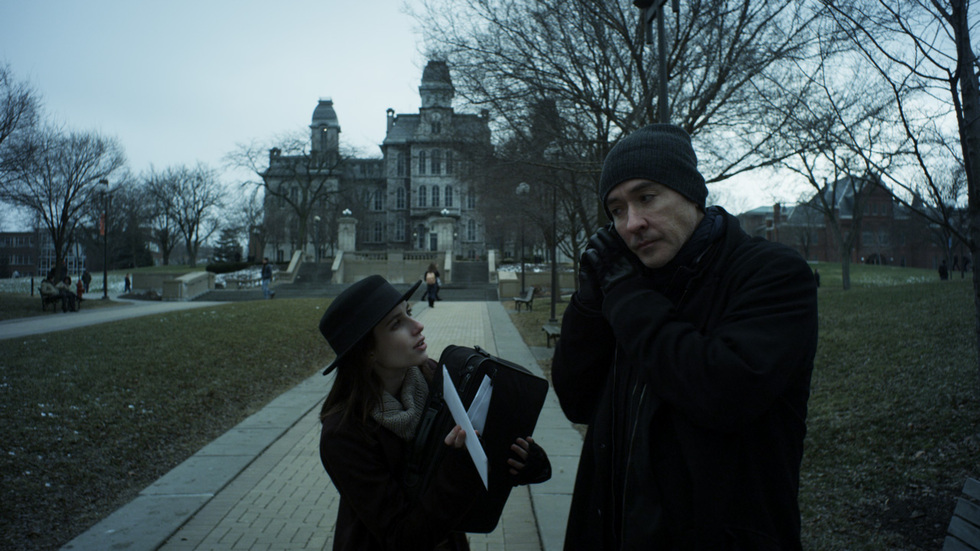
Adult World, named after the mom-and-pop adult video store where Amy (Emma Roberts) finds herself underemployed, follows Amy as she stalks her “favorite living poet” Rat Billings (John Cusack), a morose, misanthropic literary superstar, and attempts to force him into being her mentor. Directed by Scott Coffey and written by Andy Cochran, the film treads similar territory to recent disappointed-artist-post-graduation stories like Tiny Furniture and Frances Ha, but delves further into the realm of character study, pulling no punches in its portrayal of a self-absorbed character’s slow, belabored entry into adulthood.
With her hero, Sylvia Plath, looking over her shoulder, Amy contemplates suicide
Amy is a corollary to the kind of self-absorbed man-child character on which entire film genres are built. As a character she’s fairly unique, to the best of my knowledge, her only real kin is the similarly entitled and egotistical Hannah Horvath of Girls, and it’s both refreshing to watch her and depressing to be able to relate.
Similarly to how Hannah’s parents cutting her off provided the impetus for Girls, Amy’s father’s admission that he has serious financial worries and cannot continue to bankroll her lifestyle kickstarts her journey. Poetry, like other arts, is a vocation easily available only to the very wealthy and Adult World positions Amy at the difficult intersection of middle class reality and leisure class values. Unemployed and living in her parents’ house at the film’s start, Amy has $90,000 in student loans, frequently spends thousands on submission fees for poetry contests, and compares riding the bus to going through a war zone. She cancels her car insurance (with a poem), sure that paying submission fees is important in the grand scheme of things.
With her wall of blue ribbons, Amy is clearly not used to failure
Throughout the film it becomes clear Amy expects that being a successful poet will allow her to opt out of all the parts of life she considers tedious and believes anything she has to do in the meantime, such as working at Adult World, is worthy of contempt. She embarrasses and runs off customers by criticizing their sexual interests and in one incidence where she is zoned out, allows a man to steal several things and run off. Her belief that she will be famous one day soon is so pervasive that she believes they are lucky to be graced with her presence and that at the end of the day, she doesn’t really need the job anyway.
Early in the film, Amy visits her college friend, Candace, who is participating in an Occupy protest, but declines either joining in or paying any attention to their message. Though presented as an anarchist and activist, Candace, like Amy, has a supreme sense of entitlement, announcing that the only house in Amy’s price range is a shithole and with a hint of glee, that her parents would be horrified if she lived there. Amy’s response, saying to the landlord, “We’re bohemians,” suggests an attempt at romanticizing poverty.
Both girls are sheltered to a level that is cringe-inducing, something that is shown most clearly through the character of Rubia, a transvestite Amy meets at Adult World, the most exotic figure sheltered Amy can imagine. When she first encounters her in the bathroom, Amy gawks and runs out to tell the other people in the shop, like she just saw a unicorn. Later, Candace complains that as they are not children, but not yet adults, they are an oppressed minority and the camera cuts to Rubia, a real member of an oppressed minority, rolling her eyes (her default mode with Amy).
Amy’s difficult relationship with Rat Billings keeps her from being a cartoon character or drawing the audience’s hatred
As Amy’s reluctant mentor, Rat Billings is jaded and sarcastic, constantly putting her down. Under the belief that he will promote her to the right people and praise her brilliance, she works as his unpaid assistant, cleaning his house, curating his papers and assisting him in his lectures. Though Amy believes this is perfectly normal because “he doesn’t believe in money,” it’s clear to the audience that he’s taking advantage of her.
In her interactions with Rat, a sympathetic dimension of Amy’s character emerges.
She’s a young ambitious woman whose idol turns out to be a jerk but she can’t see it, who believes he has to be impressed just like all her teachers were, who believes him when he sarcastically calls her is muse. It’s incredibly refreshing to have a female character who isn’t a shrinking violet, who stalks her idol to get him to look at her art and without shame or the back stepping that most women are raised to do (“I think it’s pretty good” or “People have told me I’m good”) speaks without a qualifier, insisting “I’m good.” When Candace tells her she is getting published in Anarchist Quarterly, the first time she’s ever submitted writing anywhere, Amy goes off into her room, closes the door and screams.
Throughout the film, Amy’s lack of sexual experience is glaringly apparent. In the first scene, she develops feelings for a boy in her poetry class because he compliments her poems and when she discovers he had friends hiding in the closet filming their make-out session, he knows her well enough to try to use art as an excuse. When she first enters Adult World after seeing the Help Wanted sign, unaware of what the store is, she is scared and embarrassed. Recoiling from a vibrator as if she expects it to attack her, she runs back to her car and sits there for several minutes, shivering as if trying to get the filth off of her.
Job hunter Amy runs from Adult World just as she runs from adult responsibility
Amy uses feminism as an excuse for her discomfort and within the narrative; her views that the videos are sexist and models are being objectified are connected to insecurity over being a virgin, rather than true conviction. She is uncomfortable with people who are secure in their sexuality, looking down on Le Passion magazine’s cover model because her breasts are biggest than Amy’s head, and compensates by placing herself above them, superior as an artist. Holding this view is convenient for Amy as it allows her to dismiss a suggestion by her coworker, Alex (Evan Peters), that she write erotica based on her sexual experiences for the magazine, saying it is a bad idea because she feel anything sexualized is anathema to art not because she doesn’t have any experiences.
To this end, Amy assumes a serious mentorship involves a sexual relationship and one night, Rubia gives her a makeover so she can go seduce Rat. Dressed “like a prostitute,” Amy’s idea of seduction involves, speaking in 40s movie dialogue and tossing her head like cat, preening, while Rat sits watching her like a zoo animal. Here she becomes truly pathetic in his and the film’s eyes, admitting her virginity to him and describing sex in laughable poetry metaphors, a budding delicate flower and a grand voyage, in a stark contrast to the seedy sexuality sold in the store where she works.
Rat does not take her seriously when she insists she is a woman not a child. It’s difficult to watch her throw herself at him, a grown man moaning over his second-hand embarrassment for her and alternately patronizing and laughing at her.
In the film’s most disturbing scene, Amy begs Rat to “deflower her”
At this stage in her life, Amy is young enough that her life is still marked by what she hasn’t done. Even as a poet who idolizes Sylvia Plath, Amy does not understand depression, putting it on as a theatrical costume meant to inspire poems, before quickly shedding it to eat a grilled cheese sandwich brought to her by her mother. As such, she constantly measures herself against artists she admires, antagonizing that Rat became famous so much younger than she is now, and in the darkly comic opening scene, sticks her head in the oven and then wonders if this is suicidal plagiarism. Immediately after announcing that she doesn’t do drugs, she does pot because Rubia suggests it is something a poet would do.
Having not had any real pain in her life, nor love or anything exciting or dangerous, it is unclear what Amy has to write about. She is shocked when Rat tells her he made up his poems about heroin when he didn’t use it, feeling that one should only write about what they know. Rat’s admission ultimately leads her to try her hand at writing erotica, a place where her speculative purple prose makes her a mild success.
It’s uncomfortable how the movie surrounds clueless Amy with three men–Rat, Alex and her father–who always know better than her and constantly call her out on her naiveté. Viewers are clearly meant to see Amy as a satirical character and not take her seriously, sharing Rat’s view of her as a silly little girl following him around. When they are trading off quotes and he ends off without attribution, “You’re dumb but you’re not stupid,” she stands there silently for a beat, mulling it over, trying to find something flattering in it. It’s unclear whether we meant to laugh at her submissiveness or feel pity for her as she is being taken advantage of?
Still a child in many ways, Amy throws a temper tantrum after learning of Rat’s deception
She is overjoyed when he accepts her poem into an anthology mostly out of pity, not realizing that he never said he liked it or thought it was good, just that it was uniquely her. The pinnacle of Rat’s cruelty occurs when he reveals that the anthology he published her in is of “hilariously awful” poetry meant for reading on the toilet. Amy’s response, a temper tantrum wherein she breaks his things and screams about how special she is, proves only that she is even less mature than he thought.
Alex, Amy’s love interest, also gets a moment to criticize her work, yelling at her for thinking she’s better than the store, a place where good people work hard to support themselves.
Visiting Alex’s house, she learns he is a talented painter, but unlike her, is also an adult. He works a day job and makes the most of it, he never brags about being an artist, and he doesn’t see fame as his ultimate goal. He sees the purity of art, in making things for yourself, not to share with other people, something Amy realizes, shocked, that she has never experienced.
It’s a little unsettling for the film’s female lead to be contrasted with a man, a love interest, who is presented as superior to her in every way. Amy’s entire identity, as a talented artist, though it was probably inaccurate, is taken from her by these men in her life and she is utterly shattered by them.
Alex and Amy take a quiet moment while working at Adult World to feed their mutual attraction
However, regardless of who delivered these lessons, they were ones Amy needed to be a complete person and an adult. Rat turns out to be the kind of mentor she needed, as he makes her a better writer and gives her a harsh, but necessary wake-up call. She isn’t a bad poet, but she isn’t a good one either, to be anything she needs to go out into the world and experience it.
Alex, though unsettling as both her new role model and first sexual partner, teaches her to be responsible and accept the life she is living now as real life, not just something she’s doing to kill time while waiting to become famous.
Though it was men that taught her these crucial lessons about herself, the film succeeds by presenting the ultimate proof of Amy’s growth as self directed. She doesn’t become an adult by losing her virginity, getting a job, or by getting published, but by reading her shit poem and being able to laugh at it, already so much more grown up that she wonders how she could have ever been so naive. In the last shot, she is an adult reading words she wrote so recently as a child.
Elizabeth Kiy is a Canadian writer and freelance journalist living in Toronto, Ontario. She recently graduated from Carleton University where she majored in journalism and minored in film.
But this to me is the part we should pay attention to. When we don’t get to be headstrong, sexy scientists with daddy issues, we’re locked away. Because evidently we’re worth a lot, which while flattering, also insinuates that we are prizes that can be traded, bought, or stolen. In any film of the above mentioned genres, it’s safe to assume that at some point, the concerned wife, sexy girlfriend, or charming daughter will be kidnapped. When the body is used as a bargaining chip, the images that flood our minds are women tied to chairs, kidnappers holding phones to our crying faces, and makeshifts rag gags in our mouths.
As much as I would love to have Liam Neeson running around after me all day, I’d rather it not be because I had been abducted and stuck tied to a chair. But this seems to be one of the only ways that we get to see women on screen in today’s high stakes thrillers. In my last post, I talked about the use of rape in storytelling and its commonplace usage as a catalyst in stories. Today, I wanted to shed some light on the use of kidnapping the female body for the purpose of narrative drive.
Women have limited opportunities on screen; we all know this to be true and there are a number of reasons that this is the case. But looking beyond that fact, I think it’s important to examine the effects of these images. I don’t deny that I love fast-cutting action films. But when thinking back to a significant number of action, thriller, and psychological films, it’s challenging to think of some that don’t include the taking of a female body.
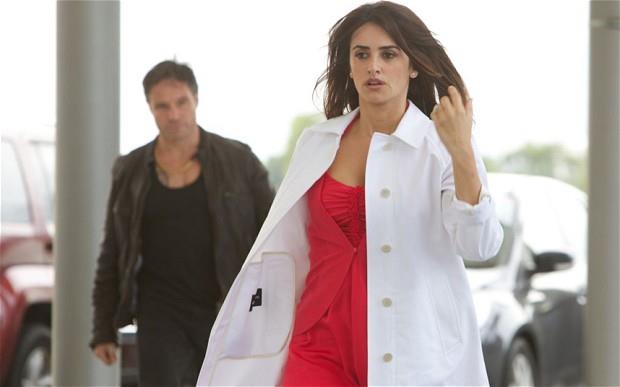
Take Blake Lively in Savages, or Penelope Cruz in The Counselor, or Maggie Gyllenhaal in The Dark Knight, or Kristen Rudrud in Fargo, or Maggie Grace in Taken.
Penelope Cruz being stalked in The Counselor
Each of these films and many, many more, use the kidnapping of a female character, of the female body, to raise the stakes. It appears we’re worth something valuable to the story. But as pieces, not players.
Blake Lively in Savages
What’s concerning with these roles is that they perpetuate the quiet and commonplace commodification of a woman’s body, and it’s become the main function of our characters on the screen. This technique of taking someone hostage has been employed in well done ways before. Looking back to The Searchers, Natalie Woods’ abduction by the Comanches still plays on classic weaker female characters, while actually bringing about the space in the film for in depth character reveals and an odyssey that exposes many people over the course of 120 minutes. In films like The Dark Knight, it feels excusable to play on classic comic book themes of revenge, taking a female character hostage, and having some heroic and uniquely strong man come to save her. It’s a model Disney employs in many of its cartoons as well.
But this to me is the part we should pay attention to. When we don’t get to be headstrong, sexy scientists with daddy issues, we’re locked away. Because evidently we’re worth a lot, which while flattering, also insinuates that we are prizes that can be traded, bought, or stolen. In any film of the above mentioned genres, it’s safe to assume that at some point, the concerned wife, sexy girlfriend, or charming daughter will be kidnapped. When the body is used as a bargaining chip, the images that flood our minds are women tied to chairs, kidnappers holding phones to our crying faces, and makeshifts rag gags in our mouths. It seems strange that Jason Bourne and Ethan Hunt can work their way out of any god-given scenario but women, even the smart ones we encounter in films, can’t seem to stay out of trouble.
The problem is that this storytelling device has been overdone and like violence, is now often used as a lazy attempt to raise the stakes and create tension. Everyone who loves anyone knows that losing that person would drive them mad. But does it always have to be the woman?
David Foster Wallace, in his heartbreaking series of shorts in Oblivion, describes all human beings as being comprised of an infinite number of eternities. It’s one of my favorite ways to understand people now. And so I ask, if that’s the case, if we’re all made up of an infinite matrix of capable emotions and therefore reactions, why has film, an art that encompasses so many senses, boiled itself down to simplistic storytelling where the best way to ignite anger or the want of revenge in someone is to “take” his woman?
Kim (Maggie Grace) hiding from her abductors in Taken
Let’s take a look at a few more contemporary films to illustrate this point, starting with Taken, and of course its sequels. Round one of Taken dishes up a nice storyline of a young American woman who travels abroad with her best friend, makes one ill-advised move and spends the rest of the film being sold into sex slavery. Meanwhile, her father, who thank god is Liam Neeson and has a very special set of skills (that he’s allowed to have, as male protagonists are), comes to save her. In Taken 2, shock me, shock me, Liam’s wife gets kidnapped. In both films, it’s the stolen woman’s body that gets things moving and that allows this stretch of space on screen for our hero.
Bryan Mills (Liam Neeson) and his special skills in Taken
In Prisoners, a powerful film with incredible performances, who is it that goes missing? Who is made voiceless? Who is rendered a token of something? While in a film like this it is integral to the reveal of character and mystery, again we should ask – why at the cost of a young woman? Hugh Jackman’s character Keller Dover embarks on a manhunt when his daughter is kidnapped with her friend. Because why not? How many models have we seen where it’s not a female? Man on Fire uses the same technique- a young woman, a young child, taken for sinister reasons because by simply holding on to her, our usual antagonists can cash out and manipulate their adversary, who we’re in turn cheering on to “recapture” the victim.
There are, of course, comedic twists like Fargo, which also happens to be a film I absolutely love. But again here, we have a female role whose purpose, while hilariously treated at times, is to be stolen, missing, and the tool in the story that the plot revolves around.
Enjoying the day’s work (Steve Buscemi, Peter Stormare, and Kristen Rudrud) in Fargo
My purpose in highlighting these tropes is that we must pay attention to the trade of the female body. If any characters in the film have a qualm, it is often settled by “taking” the other person’s loved one, and this is more often than not, a woman in their life. Our roles, as reflected back at us on screen, have limited dialogue because there is usually a rag in our faces keeping us from speaking.
We’re fed images of a woman who is made to disappear at some point in the film, left without a voice and made entirely helpless until the male protagonist comes along. This is plot device that is designed to distract from the fact that not enough story has actually been developed.
Remove the woman from this equation. You have character A wanting to get something from character B. There could be any number of mysterious ways to do this. Manipulation, lies, fights, theft, threats, coaxing. There are a thousand ways around the central and overused plot device of the female body. Personally, I think we’ve stop noticing. We’ve stopped paying attention to the fact that we are treated a commodities on screen. Not a far cry from the use of rape as a narrative catalyst, what does constantly kidnapping a woman say about what we are? We have become the stakes.
We have complacently accepted that a crime against a woman is rarely a crime against her. Rather, it’s an indirect attack against her husband, boyfriend, or father. It is a violation of the male character when the female is traded in some illicit way. Even intelligent, scientific, and clearly downplayed but sexy scientist characters somehow still find their way into these traps. We identify these crimes against women as crimes against someone else. This removes us from the responsibility of a committing a heinous crime against a female figure and makes her simply a piece in the malefaction rather than the recipient of the aggression–which she is.
This rids us of human qualities. It rids women of screen time, of dialogue, of control. It once again quietly pushes us from roles as real people in film and in life, to props for narrative mobility. In using women in this way, we visually inform ourselves over and over and over again that our only option is to wait for someone stronger to come. . We’re the thing that they need to get back.
Liam Neeson, come running for me. Anytime you want. But I’d rather it be for love than because I didn’t have enough pepper spray on me to avoid a really shitty day.
*Side note worth mentioning – in trying to find images for this article, it was surprisingly hard to find pictures of the women in their hostage situation. It’s almost like it never happened. Or you find porn.
Mara Gasbarro Tasker
Mara Gasbarro Tasker is a filmmaker based in Los Angeles. She’s currently working as an Associate Producer at Vice Media and has co-created the Chattanooga Film Festival, launching later this spring. She holds a BFA in Film Production from the University of Colorado at Boulder. She is directing a grindhouse short in April and is still mourning the end of Breaking Bad.
The general premise of ‘Someone Marry Barry’ is that every group of friends has a “Barry, “or someone who is wildly inappropriate and generally fails at life. Barry’s friends decide the best approach to mitigating Barry’s awfulness is to find him a girlfriend, because I guess he’ll be “tamed” by having regular sex with the same vagina and/or having someone to wash his boxers for him? Their plan backfires when Barry gets into a relationship with Melanie (Lucy Punch), who is just as inappropriate and obnoxious as he is (also even more funny, from the viewer’s perspective).
I am sometimes exhausted by being a “film critic,” if you’ll allow me to be so bold as to claim that title for myself. My dad used to say, “It’s hard to be Robin” when I’d get worked up into a lather over what seemed to him like minor infractions. And those little frustrations have a tendency to mount until you’re mad as hell and not gonna yadda yadda. Feminist burnout is real.
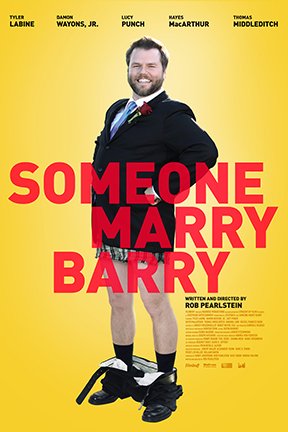
Someone Marry Barry film poster
So sometimes I just want to turn off my critical brain, set aside my gender lens, and enjoy a comedy if it makes me laugh despite whatever failings it might have, either as a work of cinema or as an artifact of gender in culture. And that’s what I did with Someone Marry Barry.
I watched Someone Marry Barry on a break from my 2014 Oscars Death Race (™ Sarah D. Bunting) which has been a particular challenge this year not only because of the bleakness of this year’s crop (and its inclusion of The Wolf of Wall Street, which I hate hate hated) but because of my limited access to recent releases in South Africa. Someone Marry Barry is one of those movies that is “in theaters” (allegedly) at the same time it’s released to on demand video services. So maybe I’m extra on it’s side because of the populism of it’s release structure? Or maybe I just needed to laugh at a romantic comedy.
Lucy Punch and Tyler Labine making Someone Marry Barry look much sweeter than it is
The general premise of Someone Marry Barry is that every group of friends has a “Barry,” or someone who is wildly inappropriate and generally fails at life. Barry (Tyler Labine, whose career path has gone from “Burnout Teen” to “Loser Manchild,” which he can hopefully ride out until he’s of sufficient vintage to play “Dirty Old Man”) ruins funerals, gets his friends fired by inappropriate talking about the boss’s daughter, and is a bad influence on their children.
Barry (Tyler Labine)
Barry’s friends decide the best approach to mitigating Barry’s awfulness is to find him a girlfriend, because I guess he’ll be “tamed” by having regular sex with the same vagina and/or having someone to wash his boxers for him? Their plan backfires when Barry gets into a relationship with Melanie (Lucy Punch), who is just as inappropriate and obnoxious as he is (also even more funny, from the viewer’s perspective).
Barry’s scheming bros (Thomas Middleditch, Damon Wayans, Jr., and Hayes MacArthur)
And man, if I had my feminist Wheaties this morning maybe I could explain how this is a subversive rejection of the Apatow-ian trope of “boys will be boys, good thing there’s all these shrews around to crack the whip.” Or maybe reject it because being given a LadyChild alongside the ManChildren doesn’t really resolve the issues inherent to that archetype. And is also not particularly groundbreaking (see Bad Teacher, in which Lucy Punch had a supporting role, or anything else Lucy Punch has been in, really).
I could also take Someone Marry Barry to task because the other women in the movie are… actually I have no idea what the other women in the movie do other than have shiny hair. One of them is really bitchy and her doormat boyfriend is inspired by missing Barry to leave her… I think?
Barry and Melanie’s inappropriate love.
What I do know: Someone Marry Barry made me laugh A LOT. As much smack as I’ll talk about Tyler Labine and Lucy Punch always playing the same characters, this really is perfect casting and it pays off. Lucy Punch in particular is at the top of her game. While the movie has pretty weak story structure and character arcs and all those other things we should fairly expect from actually good movies, it has a lot of hilarious dialogue delivered with gusto. Even the shiny-haired bitch, playing the most tired of roles, cracked me up several times (I will be stealing her whiny expectant delivery of “Juice. I need juice.” for all my future demands of my partner).
So I’m just gonna give my critical side a break and give Someone Marry Barry my stamp of approval.
Clueless’s Travis Birkenstock expresses my feelings for me
(THAT SAID: Why on earth is this movie not called Somebody Marry Barry? Why waste this perfect opportunity for delightful assonance when there is literally no difference in meaning between someone and somebody? Is there are short film from 1917 called Somebody Marry Barry? There’d better be a suitable explanation for this. Ugh, it IS hard to be Robin.)
Robin Hitchcock is an American writer living Cape Town, South Africa.
So far, this is Kristen Bell’s season to shine as the hard-hearted Jeannie Van Der Hooven on Showtime’s ‘House of Lies.’
So far, this is Kristen Bell’s season to shine as the hard-hearted Jeannie Van Der Hooven on Showtime’s House of Lies.
Whether we’re talking about the characters on Girls or (confusingly) the adorable lead on The Mindy Project, it seems like being “unlikable,” at least when we’re talking about women, has come to mean “having a personality that not everyone likes.” Far from being the sociopaths that carried Breaking Bad and Dexter, “unlikable” female characters are often women who basically mean well, but come off as being disagreeable, self-centered, or rude.
That’s unfortunate, and it raises a whole slew of questions about the way we watch television – like, “Why are we, as viewers, less prepared to love a woman who says ugly things than a man who cuts people up with a chainsaw?” – but it also distracts from the really unlikable women on TV – the ones who don’t really mean well, who hurt other people on purpose – and the challenges of telling a story about them.
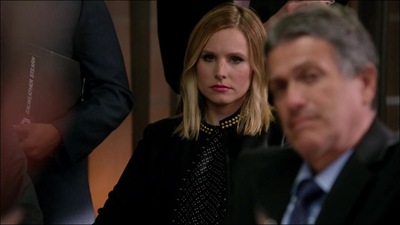
House of Lies, which is now midway through a surprisingly strong third season, has lately devoted a lot of time to the really unlikable woman in the form of Jeannie Van Der Hooven (Kristen Bell), a calculating, manipulative business management consultant who’s not only willing, but happy to destroy whoever she has to as part of her climb to the top.
House of Lies has always traded in unlikable characters – in fact, one of the problems with the first season was that there was no one to cheer for. The heroes are a team of management consultants who bullshit their clients (equally unlikable representatives of corporate America) into paying them outrageous sums of money for absolutely nothing. They sometimes crush the companies they work with, order massive layoffs, and knowingly promote products and services that are dangerous, fraudulent, or exploitative. Advertising for the third season has tried harder to frame the show as a contest between evil and evil, where we cheer for Jeannie and her one-time boss, Marty (Don Cheadle), because they’re smart and the people they’re screwing over are often equally bad. Since the start of season two, the show has worked to clarify that it isn’t a big ode to capitalism and that it’s aware of its characters’ failings.
That’s been a successful strategy overall, but things really clicked this season when Jeannie, who was never that soft to begin with, hardened up into a white-collar sociopath. It’s a move that takes all of Kristen Bell’s unflappable, charismatic charm, and transforms it into the calculated veneer of a cold-hearted snake, and it’s the most thrilling thing I’ve ever witnessed on this show.
Having split off from Marty at the end of season two, Jeannie begins season three on a high. She’s been given a big promotion at the management firm and heads her own team of consultants. She’s got the boss in her pocket, and one of the first things we see her do is steal a major account from one of her peers.
In what’s probably a nice bit of foreshadowing, Marty has a trippy dream right around the same time in which Jeannie, who’s come to kill him, is so consumed with getting revenge, and so certain of her impending triumph, that she doesn’t see danger sneak up from behind.
The next thing we know, Jeannie walks into work to discover that the firm has re-hired an old enemy of hers, a misogynist jerk called The Rainmaker. Jeannie got him fired in the first season by confessing that she slept with him to further her career (the confession itself was a calculated attempt to save her own job), and now he’s replacing pocket boss, and starting a boys club for boys with the guy she stole an account from.
The writers help us to cheer for Jeannie by reframing The Rainmaker’s actions as sexual harassment (something that wasn’t made clear in the first season) and by showing us that, regardless of what might do, she’s always going to be on the outs as a woman. They used a similar strategy with Marty in season two, highlighting the racism he faced as a Black man, and, in both cases, it’s an effective way of bringing us around to the characters’ sides. Although they’re both very greedy, conniving people, they’re also at an unfair disadvantage. It doesn’t erase our disapproval of their methods, but it helps us to celebrate their wins.
With only a few hours to process The Rainmaker’s threatening return, Jeannie completely changes her strategy, screws over Marty, steals a major client from the firm, and uses it as leverage to get equity in Marty’s private consulting company. As a parting “fuck you” to the firm, she convinces one of her subordinates – the naïve, gentle-hearted Benita, who sees Jeannie as a mentor – to torch her own career by reporting details the firm’s shady dealings to the press. To underscore what a cynical, self-serving move this is, Jeannie gives what initially appears to be a sincere speech about how she admires Benita’s principles – how they remind her of the girl she used to be – that gradually starts to turn sour as we realize she’s setting Benita up.
We can practically hear the music from Game of Thrones start to play as Jeannie climbs into the elevator, so ruthless is her victory. The following episode finds her reunited with Marty, at Kaan and Associates, where she wastes no time in alienating one of her new subordinates, Caitlin. When a client makes inappropriate sexual comments to Caitlin during a meeting, Jeannie appears to stand up for her, only to reveal, later, when Caitlin tries to thank her, that her only motive was to align herself with the client’s more decorous business partner. This is followed by an impatient, condescending lecture about how much Caitlin sucks at her job, to which she can only say “wow.”
What’s interesting about the scene – other than the fact that it passes the Bechdel Test with flying colours – is that the show allows Jeannie to be correct in the substance of what she’s saying at the same time as being bankrupt of any human warmth or compassion. It’s not an “awkward moment” kind of unlikeableness, where maybe she meant to say something nice but was hampered by some minor personality flaws – she’s being harsh on purpose. And, in back to back episodes, we see this come out specifically in situations where we might normally expect her to nurture, encourage, or support other women who look up to her. It’s a dynamic we don’t often see on TV (especially not from this side), and it’s fascinating to watch.
Jeannie finishes the episode off by going home early, and making sure that Marty sees that she’s going home early, in order to remind him that he’s not in charge. Marty, who’s been trying to make peace with Jeannie, and sees her as being somewhat of a friend, explains in a fairly heartfelt way (while still trying to re-establish control) that he worked very hard all his life to have something that was his, and that she should appreciate what it means that he gave her half of it. Jeannie rejects him and says, “You didn’t give me anything. I took it.”
The moment she says it, we know that it’s true. Everything she’s done makes sense from a practical point of view, but there’s a meanness, and an anger underneath. This is a woman who knew she was taking half of his dream and did it, in part, just to hurt him.
Jeannie’s story line this season isn’t just interesting because of the way it characterizes women, but because it represents House of Lies becoming what I think it wants to be — evil versus evil; the smart and the mean outfoxing each other; what Marty and Jeannie have made themselves into, to take things from people they hate.
I’m loving this season more than I thought I could love House of Lies, and it’s all down to one of the worst people I’ve ever seen. A woman I would never want to be in the same room with, who’s vindictive, and greedy, and mean, at the heart of a story about power and people who scrape themselves raw just to get it.
I’m excited to see how this ends.
Katherine Murray is a Toronto-based writer who yells about TV and movies on her blog.
This reveals one of the key weaknesses of incorporating token women in action movies. Token women are not real characters, they exist to tick boxes so that filmmakers can point to these characters and say “See we aren’t sexist, we had a woman and she even punched a dude in the face!” However because these aren’t real characters they end up being almost exclusively objects for the male gaze and to be fair, for Dahl this was not nearly as bad as it can sometimes be. She has a functional uniform not much different from her male colleagues and she is only subject to a couple of minutes of gratuitous nudity.
Action movies are perhaps the worst and most consistent offenders when it comes to failing the Bechdel Test, a depressingly bare minimum for assessing the female presence in a given film or TV offering. Riddickis no exception; like the other movies in the franchise, it is very much a one man against the world sort of scenario. Previous Riddick movies Pitch Black and The Chronicles of Riddickhave at least managed to have interesting women characters. Pitch Black even managed to pass the Bechdel Test. Sadly Riddick does not even come close as it falls back into the old action movie trap of only having one named female character in a sea of men.
In Riddick, Vin Diesel once again takes on the titular role. It takes place shortly after the end of The Chronicles of Riddick where Riddick was made the Lord Marshal of the Necromongers after having dealt to the previous one due to the Necromonger law of “You keep what you kill.” Over the course of the previous movie, The Chronicles of Riddick, we find out that Riddick is perhaps the sole surviving member of a race called the Furyians and he becomes captivated with the idea of discovering more about the history and demise of his people. Riddick opens with him convincing a Necromonger general to give him the location of his home planet Furya, so that he can go have a nosey. Unsurprisingly he is tricked and ends up on an extremely inhospitable planet all alone struggling to survive. He soon has an urgent need to get off planet when he realises the rain poses a very real threat and so activates a beacon on an abandoned bounty hunter ship that alerts nearby mercenaries to his location. They appear speedily as there is a massive bounty on his head and it is worth double if he is brought in dead.
As I watched the first 30 minutes, I was all like, “Huh. They aren’t going to have even a token woman in this movie, interesting.” This would have been sad as the franchise has had some interesting women characters, historically. Then they revealed that one of the mercenary ships had a female prisoner on board. She was cut loose because if they captured Riddick the ship would be overweight. I think she probably had under a minute of screen time that ended with her being shot for sport by the captain of the ship. I suppose it was meant to underscore just how big of a douche the mercenary captain, Santanna, was. However the killing of women on screen to emphasise the evilness of male characters has become so routine that the scene was more mundane than horrifying, we knew she was going to die the moment she was set free. Her death also serves as motivation for Riddick, the unnamed woman was both brown and a prisoner, two things Riddick can identify with I guess. After she is shot we see Riddick looking grim and presumably deciding to kill all of these mercenaries for being heartless assholes toward pretty ladies.
Clearly by this point it wasn’t looking great for women in this movie. As the second batch of mercenaries arrive we are soon treated to the fact that one of them is Katee Sackhoff, most renowned for playing the tomboyish pilot and complicated woman, Starbuck on Battlestar Galactica. She plays second in command of the second, less vile mercenary ship. Immediately on arrival she is hit on by Santanna in an unsurprisingly crude manner. Her response is to punch him in the face and then tell him that “I don’t fuck guys.” The statement seemed a little out of place and reads as though he is out of line for hitting on her because she is a lesbian, not because it is rude and annoying in a professional context. But OK, I can happily roll with an openly gay heroine on a mainstream action movie even if it is introduced kind of weirdly. Sadly this is as about as good as the character gets. Throughout the rest of the movie she constantly has to use her fists on Santanna, something that actually makes her look ineffectual as a leader, rather than presenting her as an ass-kicking woman as was no doubt intended. Movies seem to have fallen into convenient shorthand where a woman who is able to exact violence on a man is a good female character because she is not a passive victim. This is not the case, a woman can still kick butt (and in this case it is a pretty nominal amount of butt kicking) and still be a terrible female character.
This is reinforced when Dahl is subject to gratuitous shower scene where we see one of her nipples and Riddick leering in from the window; he is trying to steal her toiletry kit, not harm her, but the threat is there. The implication is that he could do anything to her at this point and she would be powerless to stop it. The whole scene serves to underline how vulnerable she is as a woman despite her ability to repeatedly punch Santanna in the face.
This reveals one of the key weaknesses of incorporating token women in action movies. Token women are not real characters, they exist to tick boxes so that filmmakers can point to these characters and say “See we aren’t sexist, we had a woman and she even punched a dude in the face!” However because these aren’t real characters they end up being almost exclusively objects for the male gaze and to be fair, for Dahl this was not nearly as bad as it can sometimes be. She has a functional uniform not much different from her male colleagues and she is only subject to a couple of minutes of gratuitous nudity.
It does get worse though. When Riddick is captured by the mercenaries, he makes a few predictions, the first is that Santanna will not live for more than five seconds after he is free and the second is that he will end up “balls deep” in Dahl but only after she asks him “real pretty like.” This is pretty gross, but not really surprising in an action movie that revolves around a single hyper-masculine protagonist. What transforms it from pretty gross to slimy homophobic misogynist bullshit is later, when Riddick is stranded on a rock surrounded by many creatures who want to kill him, he is rescued by Dahl from a transporter in a safety harness. He grabs her ass and she says to him, “I have something to ask you, real pretty like…” At the end of the movie Riddick says, “Tell Dahl to keep ‘er warm for me.” This is basically embracing with open arms the myth that every lesbian just hasn’t met the right man. This myth is not only demeaning of a woman’s sexuality, but it is dangerous, it is at least partially responsible for the fact that the incidence of rape for lesbians by men is higher than for women generally. I’m sure people could argue that they are simply joking, but I don’t think that flies in the context that Riddick says to her while making a series of predictions that all come true with grave consequences.
It is hard for me not to wonder, is a token woman in an action movie worse than no woman at all? At least then we would not have to deal with the casual objectification and reinforcement of dangerous myths. Of course that isn’t really the answer–women shouldn’t have to choose between shitty representation and no representation at all. A token woman in an action movie is never a real character; she exists as a box ticking exercise, a device by which we can learn things about male characters and to provide fodder for the male gaze. Obviously not every character in every movie can be fully realised but more often than not these two dimensional parts are the province of women and/or people of colour. Riddick was no exception to this except perhaps in that Vin Diesel is not really read as white. I hope that the next movie will return to the roots of the franchise and provide us with female characters of substance and complexity.
__________________________________________
Gaayathri is a writer currently located in Kuala Lumpur, Malaysia, although this is set to change soon. She is the child of diaspora two times over and is passionate about all forms of social justice. She likes to travel and prefers television to movies; however, she feels a strange compulsion to watch all movies that have fish-eating people in them, no matter how terrible they are. She has a Bachelor’s degree in Political Studies from the University of Auckland and she has spent her formative years working at various types of feminist organisations from the community to the regional in both New Zealand and around Asia. Her work has been featured around the feminist blogosphere including Flyover Feminism, Feministe, and Leftstream as well as in United Nations and NGO publications. You can find more of her work at her blog A Human Storyand tweet her @A_Gaayathri.
And it sinks in. We can, half a world away, celebrate Pussy Riot’s name. We can listen to their music and cheer them on. What our challenge as feminists needs to be is to take their cause as seriously as those Carriers of the Cross take it. We must hold on so tightly to our convictions–at home and abroad–that the utter fear and terror of female power that those enmeshed in the patriarchy are emboldened by is neutralized.
Pussy Riot–the Russian feminist anti-authoritative protest punk band–staged a protest at Moscow’s Cathedral of Christ the Saviour two years ago. Their subsequent arrest, trial, and incarceration has been broadcast to a world both condemning and sympathetic of their cause.
Because of this, we’re hearing the word “pussy” thrown around on the news and in the classroom like never before. Teaching film and journalism, I think I said it in class a half dozen times in the last 24 hours. NPR’s calm deliverance of the word is almost soothing.
It’s hard to not delight in so much “pussy”—the word, as they use it, is threatening, terrifying, and forceful. It’s also a word that is used to belittle women or shame men. There’s power in the word, but there’s also silliness in the reception. The word itself is analogous to women themselves and how we inhabit this world—we often aren’t taken seriously, but us having power (especially sexual power) is terrifying to patriarchal forces. Pussy Riot has shown us this in a loud, brightly colored way.
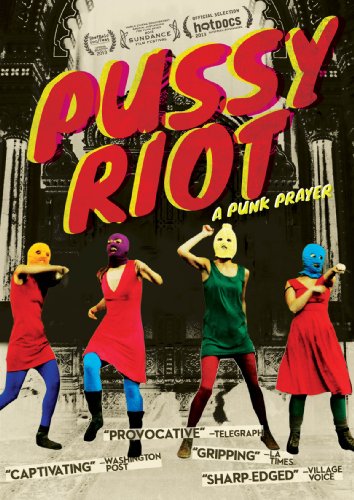
The documentary Pussy Riot: A Punk Prayer–now available on DVD—traces the path of Pussy Riot’s inception and worldwide explosion. The dozen or so women who gathered to form the punk collective in 2011 were galvanized by pro-feminist, anti-capitalist, pro-gay rights, anti-authoritarian, anti-Putin, anti-church/state ideologies. Their guerrilla-style performances with their signature brightly-colored balaclavas became known in feminist circles, but their February 21, 2012 performance was what made them a household name.
The documentary shows the group preparing for a concert/protest at the Cathedral of Christ the Saviour, Moscow’s Orthodox church. It feels voyeuristic (in a good way) to watch this guerrilla punk group practice just like any other band.
As the film’s exposition builds, the group plans to storm the cathedral (which they say is the ultimate symbol of the relationship between the church and state), go up to the altar (where they point out women are now allowed, and they believe they should be), and perform “Punk Prayer.” The lyrics to the anthem include the lines,
“Virgin Mary, Mother of God, banish Putin, banish Putin,/ Virgin Mary, Mother of God, banish him, we pray thee!…/ Freedom’s phantom’s gone to heaven,/ Gay Pride’s chained and in detention… /Don’t upset His Saintship, ladies,/ Stick to making love and babies./ Crap, crap, this godliness crap!/ Crap, crap, this holiness crap!/ Virgin Mary, Mother of God./ Be a feminist, we pray thee…”
However, they are only able to perform for less than a minute before being dragged away by security officials and grabbed at by angry cathedral visitors (there was not a service going on at the time). Three of the members were arrested—Nadezhda Tolokonnikova (Nadia), Maria Alyokhina (Masha/Maria), and Yekaterina Samutsevich (Katia)–and Pussy Riot: A Punk Prayer delves into their lives and the court case that awaited them.
Pussy Riot performs briefly at the cathedral
The film–directed by Mike Lerner and Maxim Pozdorovkin—does an excellent job of letting us into the women’s lives. Their testimonies, their words to the press, and their families’ words, along with the footage of their performances, illuminate their entire story. While it’s clear that the filmmakers are pro-Pussy Riot, their allegiance isn’t distracting. For the first part of the film, as they cut between images of church, state, and protest, Pussy Riot’s performances seem like performance art, not acts of all-out revolution. We viewers think to ourselves as they get dragged off and arrested at the cathedral, “Really?”
“Their actual ‘offending’ performance was a quick and amateurish mess. It was a poorly organized and naïve display by the young women, making the punishments placed upon them—two years in intensive labor camps—appear even harsher by comparison. Out of this, the directors are able to show the growing maturity of the women’s court statements as their ‘show trial’ cage inevitably provides them an international platform on which to express their views.”
When the women are shown speaking (whether in detention or in court), they sometimes smirk and smile and certainly use the platform as activists. At one point, they say to each other that the press will use these photos of them smiling to show that they’re happy, and they say that they are actually laughing at the press. We know that their punishment hasn’t started in earnest yet, and so do they.
I found myself wanting, at times, to judge them for those smiles and testimonies that didn’t defend them sufficiently against the charges (“hooliganism motivated by religious hatred”). I realized, in my judgment, that I am part of the problem. Would I have responded that way to a documentary about young male activists? The rarity of seeing women fight and be punished on a national stage feels too rare. We—around the world—notoriously dismiss young women and find them silly. Our response to their name is indicative of that reality.
From left: Katia, Masha, and Nadia await their sentencing in a confined box in the courtroom.
We find them silly, or we find them terrifying. Rarely do we give them power.
The chilling reality of Pussy Riot’s case sets in when the filmmakers follow the anti-Pussy Riot protesters, Orthodox worshipers, and men who belong to “The Carriers of the Cross.” Women holding images of Madonna and child are disgusted with Pussy Riot, and the men say,
“Those girls really offended me… in the 16th century, they would’ve hanged them, they would’ve burned them.”
“The main one, she is a demon with a brain. She’s a strong demon. She is stubborn, you can tell by her lips, her mouth.”
“There have always been witches who won’t repent.”
And it sinks in. We can, half a world away, celebrate Pussy Riot’s name. We can listen to their music and cheer them on. What our challenge as feminists needs to be is to take their cause as seriously as those Carriers of the Cross take it. We must hold on so tightly to our convictions—at home and abroad—that the utter terror of female power that emboldens those enmeshed in the patriarchy is neutralized.
The disgust for female power is palpable in these scenes, and it is familiar. While America doesn’t have the same history as Russia, that vitriol feels familiar.
In the St. Petersburg Times, mere days before the arrest at the cathedral, a lengthy feature was published about Pussy Riot:
“The group cites American punk rock band Bikini Kill and its Riot Grrrl movement as an inspiration, but says there are plenty of differences between them and Bikini Kill. ‘What we have in common is impudence, politically loaded lyrics, the importance of feminist discourse, non-standard female image,’ Pussy Riot said. ‘The difference is that Bikini Kill performed at specific music venues, while we hold unsanctioned concerts. On the whole, Riot Grrrl was closely linked to Western cultural institutions, whose equivalents don’t exist in Russia.'”
We can watch this documentary and the news reels of Bolshevik Revolution and the footage of the original Cathedral of Christ the Saviour being demolished under Stalin. We don’t have the same history. But we have the same enemies.
Pussy Riot: A Punk Prayer is an excellent documentary that reminds us of the threat women pose to the patriarchy–literally and figuratively. And when the women might seem young and naïve at the beginning of the film, we watch them mature, and we realize how serious both their punishment and the society that accepts such a punishment are. We hear Pussy Riot’s performance at the end of the film (footage from an earlier performance) as brilliant and powerful. And we realize, deeply, that we live in a world that needs Pussy Riot.
Kathleen Hanna said, “Anything is possible, if anything, this band has reminded us of that.”
Katia was granted a suspended sentence during the filming of the documentary, but Nadia and Masha went on to serve almost two years in labor camps. They were released in December 2013, which many saw as a false show of amnesty before the winter Olympics began in Russia.
A lot of rapes that occur on film and TV are unnecessary and unrealistic while subtly serving to punish the rape victim, to pruriently show the dehumanization of victims (most frequently women), and to trigger audience members who are survivors. A show like ‘Bates Motel’ that so cavalierly uses a tired and painful device in its first episode is definitely not worth my time.
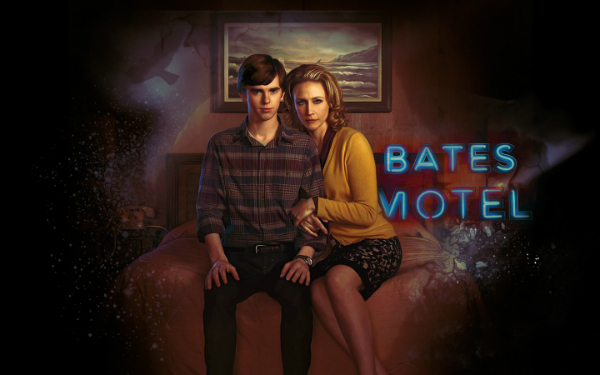
Bates Motel drawing
Written by Amanda Rodriguez Trigger Warning: Rape, Sexual Assault
Since I really liked Alfred Hitchcock’s Psycho when I was younger, I decided to give the A&E prequel series Bates Motela try. Despite that the cinematography was rich, the actors were quality, and the atmosphere was a great mix of foreboding while paradoxically retro and contemporary, I was roughly halfway through the first episode when I turned it off and washed my hands of it. What makes me think I can give a worthwhile review of a series that I watched for only 20-30 minutes? A rape occurs in that first episode about halfway in, and I know enough about TV formulas, characterizations, and plotlines to safely determine that this rape was gratuitous. A lot of rapes that occur on film and TV are unnecessary and unrealistic while subtly serving to punish the rape victim, to pruriently show the dehumanization of victims (most frequently women), and to trigger audience members who are survivors. A show like Bates Motel that so cavalierly uses a tired and painful device in its first episode is definitely not worth my time.
The Bates Motel at night
I generally think rating systems, especially Hollywood’s, are for the birds (maybe even the Hitchcockian birds… har, har). The MPAA (Motion Picture Association of America) is a joke with its Catholic priest sitting in on viewings along with its hatred of all things involving female pleasure (check out the documentary This Film Is Not Yet Rated to learn more about the secret society that is America’s rating board). I’ve been known to gleefully watch trailers, waiting for the rating description only to scoff, mock, and laugh. My personal favorite is still, “Some scenes of teen partying.” However, maybe I wouldn’t mind a system that cued its viewers in a way that, say, the new Swedish rating system does by integrating the now famous Bechdel Test to judge the level of female involvement in a film. If we’re going to be given a heads up about a film or TV show’s content prior to watching it, there should absolutely be a trigger warning system. The number of survivors of PTSD (post-traumatic stress disorder) seems to be growing every day, so the compassionate, responsible thing to do would be to let viewers know if there are scenes of combat violence, sexual assault, child abuse, etc.
Norma Bates is attacked in her home
To give you an idea of the visceral response seeing certain triggering acts on film can cause in someone with PTSD, I’m going to describe to you what happened to me while watching the scene in Bates Motel where Norma Bates was attacked and raped in her home. The former owner of the Bates property, Keith Summers, breaks into the Bates house when Norma is home alone. He attacks her with a knife, brutally beats her, and rapes her. The familiar prickling of my skin and elevated heart rate kicked in when it became clear that Keith was planning to rape Norma. My thoughts were racing; I kept telling myself that she would get away, that she would fuck his shit up because she’s a manipulative murderess, but that didn’t happen. As Keith raped Norma, I found myself in a blind panic, yelling aloud, “STOP! STOP! STOP!” while crawling across the floor to get to the TV to turn it off because I no longer had the motor functions required to walk or use a remote control. After turning off the TV, I sat on the floor, breathing heavily, staring off in a daze. I did housework then, trying to calm down, trying to lift the feeling of dark ooze filling up inside me. After several hours of this, I was lucky enough to have a kind and perceptive friend call me, discern something was wrong, and let me vent about how upsetting and unnecessary the scene was.
Norma cleans up blood.
I ask you, should anyone be forced to go through that? I’ve continued to be bothered by that scene days later and outraged enough to be compelled to write about it. If there had been a warning at the beginning of the episode that it contained scenes of sexual violence, I would’ve been prepared or, more likely, chosen to watch something else.
Despite the fact that I was triggered by this scene, I have thought and thought about it as objectively as possible to discern whether or not the scene did have value, and my conclusion is that Norma’s rape was, in fact, a broad application of a storytelling technique that is overkill. The scene is designed to render Norma helpless and to give justification to her future actions and neuroses. Guess what? Norma was already crazy before she was raped; she may or may not have murdered her husband, and he may or may not have been an abusive asshole. She already had an unhealthily sexual relationship with her son as evinced by her jealousy, possessiveness, and physicality with him. Not only that, but home invasions are traumatic events on their own. Having her home broken into and being beaten and knifed by a man are all enough to give Norma PTSD and to incite dysfunctionality. We already have all the justification for her behavior here without having Norma raped as a cheap plot device.
Bloody Norma Bates
What is the function, then, of having Norma raped? Would this have happened if young Norman, instead, was home alone and Keith had attacked? It’s hard to see Norma’s rape as anything other than bringing a powerful woman low, turning her into an object that is acted upon, divesting her of her status as a subject. I also can’t help but see Norma’s rape as an intended lesson for Norman. After Norma told him he couldn’t go out, Norman climbed out of his window to hangout at a party with some cute girls. Knowing his mother was attacked and raped and he wasn’t around to stop it does more to service the forwarding of Norman’s feelings of responsibility and male protectiveness towards his mother, which I think still would’ve been possible if Norma suffered a home invasion and not a rape. This means Norma’s rape isn’t even about her. Talk about lack of subjectivity.
Norma and Norman after the attack
Norma’s rape is also problematic in the same way that many Hollywood depictions of rape are: they are intensely physically violent. Of course, rapes like that occur, and, of course, strangers rape people they’ve never met, but these things don’t happen with nearly the frequency their coverage by mainstream film and TV would lead us to believe. In addition to Bates Motel, some key examples of these physically brutal rapes are: The Girl with the Dragon Tattoo, Downton Abbey, House of Cards (the rape is described by the survivor…not shown), Leaving Las Vegas, I Spit on Your Grave, and Straw Dogs (a Peckinpah film that caused massive controversy and was banned in the UK because the rape victim actually began to enjoy her rape). The list goes on and on. The problem with rape scenes like these are that they obscure and delegitimize rapes that are perpetuated without physical abuse. As far as the media is concerned, rapes where the victim is beaten are more cut-and-dry. The rape that occurs between friends or a married couple where the victim simply says “no” are apparently more questionable as to whether or not the victim “wanted it.” Depictions of such monstrous acts make it hard to see our fathers, brothers, husbands, and friends as rapists, but, most of the time, that’s who they are, not the psychotic strangers Hollywood would have use believe in.
Norma Bates meets her attacker
This mentality and this refusal to show the true gamut of situations in which rape and sexual assault occur is harmful to survivors. Because their rape didn’t involve slapping and screaming, it takes a long time for many survivors to even acknowledge and accept that they were raped. Many survivors doubt that their claims will be believed. Many survivors’ claims aren’t believed. This allows many perpetrators to go free without any consequences, and because there was no kicking and crying, I suspect many perpetrators don’t even believe that they are rapists. Isn’t that a scary thought? We value nuance and realism in film and TV characterization; why don’t we place the same value on the varied experience of survivors? Rape culture insists that we only see a narrow representation of rape because if we admit that rape occurs in so many different contexts and with so many different circumstances, then we must admit that rape is a pandemic, that survivors are telling the truth, and that we need to do something about it.
——-
Amanda Rodriguez is an environmental activist living in Asheville, North Carolina. She holds a BA from Antioch College in Yellow Springs, Ohio and an MFA in fiction writing from Queens University in Charlotte, NC. She writes all about food and drinking games on her blog Booze and Baking. Fun fact: while living in Kyoto, Japan, her house was attacked by monkeys.
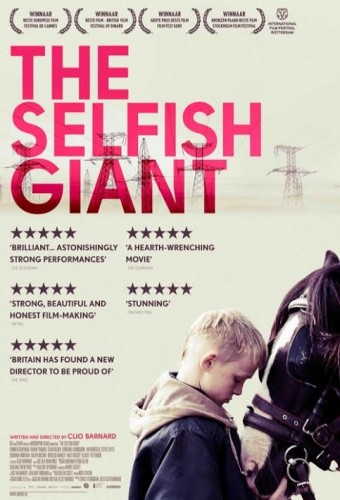
The British Academy of Film and Television Arts Awards took place on Sunday night. One of the films nominated for “Best Outstanding British Film” was the critically-acclaimed ‘The Selfish Giant’ (2013). It lost out to the sci-fi juggernaut ‘Gravity’ but it is a powerful, low-budget film that deserves a greater audience. ‘The Selfish Giant’ was, also, the only nominated film in that category written and directed by a woman. The director’s name, of course, is Clio Barnard and my primary aim, this post-BAFTA Tuesday, is to appeal to readers to seek out her films, if you haven’t already done so.
The British Academy of Film and Television Arts Awards took place on Sunday night. One of the films nominated for “Best Outstanding British Film” was the critically acclaimed The Selfish Giant (2013). It lost out to the sci-fi juggernaut Gravity, but it is a powerful, low-budget film that deserves a greater audience. The Selfish Giant was, also, the only nominated film in that category written and directed by a woman. The director’s name, of course, is Clio Barnard and my primary aim, this post-BAFTA Tuesday, is to appeal to readers to seek out her films, if you haven’t already done so.
The Selfish Giant is a beautifully made film about the friendship between excluded boys on the margins of British society but the director has also made another remarkable film about alienated, disadvantaged women. I’m talking about The Arbor (2010), Barnard’s innovative and involving documentary about the life and career of British playwright Andrea Dunbar. The Arbor was also critically acclaimed. Barnard won Best New Documentary Filmmaker at the Tribeca Film Festival of 2010 as well as a British Independent Film Award.
Clio Barnard
Andrea Dunbar was a teenaged, working-class literary star and mother of young children from a deprived area of Bradford in West Yorkshire. Her autobiographical plays were produced at The Royal Court Theatre in London in the early 80s. An important cultural voice of underprivileged youth in divided Thatcherite Britain, the playwright died of a brain haemorrhage in 1990 after collapsing in a pub. She was only 29 years old. But the documentary not only tells the story of the dramatist’s extraordinary short life; it also focuses on the tragic fate of her eldest daughter, Lorraine Dunbar. Let’s take a closer look at The Arbor before returning to the current success of The Selfish Giant.
Andrea Dunbar grew up on the run-down Butterworth Estate in Bradford, on a street called Brafferton Arbor. She wrote about the world around her and drew from her own life. Her thematic concerns included intergenerational and interracial relationships, domestic violence, teenage pregnancy, and alcoholism. Dunbar’s play, The Arbor (1980) is about teenage pregnancy while Rita, Sue and Bob Too (1982) is about two teenaged girls who are having an affair with the same older, married man. For Dunbar, the role of the writer is to tell the truth about her world. In a featured TV interview, she observes, “Nowadays, people want to face up with what’s actually happening coz it’s actually what’s said. And you write what’s said. You don’t lie. If you’re writing about something that’s actually happening, you’re not going to lie and say it didn’t happen when it did all the time.”
Connor Chapman (Arbor) in The Selfish Giant
Clips are shown of the film adaptation of Rita, Sue and Bob Too (1987) but Barnard adopts a more original approach with The Arbor. The documentary features excerpts of an open-air performance of the play on the same estate today. The Arbor is, in fact, a deeply absorbing and stylistically adventurous documentary. Fiction and fact echo and combine. The film does offer interesting glimpses of the writer, and her family, in archival footage, but what makes it inventive is the sustained use of actors to voice the people who knew Dunbar. Their observations and memories of her are quite perfectly lip-synched and performed. Barnard is intrigued by verbatim theatre where actors speak the words of interviewees. Of particular interest to her was A State Affair, a verbatim play by Robin Soans that revisited Andrea Dunbar’s home in 2000. Barnard states in the production notes of The Arbor that her radical intention to apply verbatim techniques to film is to “make the audience aware they are watching a construct.” This makes for an artistically and intellectually stimulating viewing experience. The distancing effect encourages the viewer to question orthodoxies about documentary filmmaking, particularly questions regarding truth and representation.
The Arbor (2010)
Dunbar’s life was eventful and extraordinary. How many writers have been teenaged literary stars and mothers? She did not conform to culturally conservative, working and middle class norms of feminine behavior. She was a right-wing tabloid’s living nightmare: a young working-class mother with three children by three different fathers. Barnard’s approach does not serve to pass any judgment on the writer. Family members and former partners recall Dunbar and their reminiscences and attitudes towards the writer sometimes conflict; Dunbar herself is glimpsed in interviews and comes across as an intense, shy-looking figure. She was, it seems, a complicated character. Lip-synched voices of her family testify to child neglect and hard drinking but it is equally evident that Dunbar was a young woman with deep insecurities. A victim of male exploitation and violence, she spent time in women’s refuges. She, also, most likely suffered from depression and alcoholism.
The Arbor also examines the difficult relationship between Andrea and her biracial daughter, Lorraine. Lorraine’s father was of Pakistani heritage and she observes that her mother’s situation was very unusual on her “all-white, very racist estate.” Virulent racism was commonplace in Yorkshire in the 80s and Lorraine’s memories of the racism she experienced within her own family are disturbing to hear. She even recalls overhearing her own mother- back from the pub- make the sickening, soul-destroying confession to another that she did not love her as much as her other children because of her race. Her relatives, she maintains, also denied her Asian heritage. Lorraine further maintains that her mother was uncaring and unloving in general.
Playwright Andrea Dunbar with daughter Lorraine
Lorraine’s white half-sister, Lisa, disagrees with her characterization of their mother and claims it covers deep hurt over her loss. What is clear is that Lorraine simply unravelled after her mother’s death. Her life was blighted by bullying and drug addiction. She fell into sex work to pay for her habit and, like her mother, became a victim of domestic violence. Lorraine was imprisoned in 2007 for the manslaughter–through neglect–of her two-year-old son who died after ingesting methadone whilst in her care. It perhaps comes as no surprise to learn that she actually preferred prison life.
The Arbor is a unique, evocative portrait of creative talent and inter-generational pain. Both mother and daughter suffered from terrible demons but Barnard’s approach does not offer easy explanations. The young literary star from the streets of Bradford remains a mystery, in many ways, and we are encouraged to ask if we ever really know the truth about someone. The documentary is about an extraordinary woman from a particular place but it deals with the universal theme of family. Are we not all shaped by our families, if not haunted by them? The poet Philip Larkin wrote in This Be The Verse: “They fuck you up, you, your mum and dad/They may not mean to, but they do./They fill you with the faults they had/And add some extra, just for you.” Whether you concur with his darkly amusing observation, The Arbor makes you think about what we inherit from our parents. Another theme is the nature of creative talent and I took away from the documentary an acknowledgement that creativity does not always come in clean, little packages. The film also makes the viewer reflect on the impact of poverty, class, and racism on the psyche of human beings.
Manjinder Virk as Lorraine Dunbar
The Arbor contributes to our understanding of the dramatist in a compelling, original ways. It is an important feminist work too in that it restores to the collective memory the story of a young, disadvantaged female cultural figure while drawing attention to the plight of young girls struggling to survive in societies where racism, lack of opportunity, and masculinist violence are all-pervasive.
In the narrative film, The Selfish Giant, inspired by the Oscar Wilde short story of the same name, Barnard addresses the troubles of two young boys growing up in the same economically deprived area of Bradford. It is, of course, important for female filmmakers to examine masculinity as well as femininity. The Selfish Giant sheds light on both the aggressiveness and vulnerability of boys. Barnard’s lads are lost and disadvantaged. Arbor (Conner Chapman) has a drug-addicted older brother and Swifty (Shaun Thomas) comes from an extremely large, needy family. Both have been excluded from school for discipline problems. Arbor is an angry, insecure lad with ADHD. Swifty is more unassuming. An animal lover, he is a natural with horses. Kicked out of school, the boys resort to scrap metal dealing and get involved in illegal “sulky” (or harness) racing. Arbor feels left out when Swifty is chosen to be the sulky rider of a scrap metal dealer called Kitten (Sean Gilder). He also steals from him. Punishment is a risky but potentially profitable mission that ends in tragedy.
The boys of The Selfish Giant
The Selfish Giant highlights the exploitation of children by adults but it is also a sensitive study of male friendship. Arbor can be belligerent but he can also be engaging, even affectionate. He loves his friend and the friendship moves the viewer because we realize that it is his only authentic relationship. Barnard understands that his bravado masks raw sensitivity. Arbor’s home, for Swifty, is a refuge from the insecurity and turmoil of his family life. Chapman and Thomas, it must be said, deliver persuasive, natural performances as the boys.
The Selfish Giant is a hard-hitting, sometimes harrowing, film. Of course, there are those who would charge Barnard with exploiting poverty as well as giving a too depressing picture of the lives of poor people in the UK. I would not, however, accuse the director of being a class tourist. Although the daughter of a university lecturer, she grew up in West Yorkshire and knows the area in question well. The Selfish Giant is not manipulative. It engages you emotionally but it is not sentimental. In fact, it grows more powerful and beautiful as the story unfolds. Stylistically, The Selfish Giant is a social realist tale with a modern, picaresque feel. The spiritual themes of Wilde’s story also become more apparent as the film develops. Barnard’s formidable sense of place is, again, manifest. The Selfish Giant’s post-industrial, semi-rural landscape is shot with skill and imagination. This world does not lack poetry but Barnard endows it with an austere power. In short, The Selfish Giant is a beautifully made film that that needed to be made, and needs to be seen. It critical successes–BAFTA nomination and Europa Cinemas prize at Cannes in 2013–are richly deserved.
Sulky harness racing (The Selfish Giant)
Clio Barnard is not frightened of tackling tough subjects. She is concerned with the marginalized and the forgotten–untutored children, abused women, anguished addicts and wayward, natural-born artists. Both films explore the alienation of the English underclass and working class. They are not directly political but it is clear where the director’s ideological sympathies lie. The films show what poverty does to people psychologically. This is, in fact, what they are ultimately about. There is a sureness and artistry in Barnard’s directing and her work has been both aesthetically striking and intellectually engaging. Stylistically, her films so far have revealed experimental daring as well as strong social commitment. I hope she goes on to make many more beautiful, thought-provoking films. Let’s celebrate her rise.
But mainstream movies have so much asinine fakery in them, from CGI that looks as if it came off the side of a van in the 1970s to the Manic Pixie Dream Girl, audiences hunger for the real. In a time when big American news media are shutting down their offices in other countries (to save money) and more and more Americans are getting their news through the Daily Show and the Colbert Report Jehane Noujaim’s ‘The Square,’ which is nominated for an Oscar for Best Documentary and just won The Director’s Guild Award in the same category and Luciana Kaplan’s ‘Eufrosina’s Revolution,’ which was part of Hot Docs and was shown in New York’s 2014 Athena Film Festival follow up on international current events with a thoroughness that is anathema to our amnesia-prone mainstream news media.
Documentaries are the type of feature-length films much more likely to be directed by women: 39 percent of documentaries have women directors as opposed to 18 percent for narrative features. Perhaps not coincidentally documentaries are also some of the lowest-grossing films at the box office, the brussels sprouts of the film world–good for you, but not the first thing anyone orders off the menu.
But mainstream movies have so much asinine fakery in them, from CGI that looks as if it came off the side of a van in the 1970s to the Manic Pixie Dream Girl, audiences hunger for the real. In a time when big American news media are shutting down their offices in other countries (to save money) and more and more Americans are getting their news through the Daily Show and the Colbert Report, Jehane Noujaim’s The Square, which is nominated for an Oscar for Best Documentary and just won The Director’s Guild Award in the same category, and Luciana Kaplan’s Eufrosina’s Revolution, which was part of Hot Docs and was shown in New York’s 2014 Athena Film Festival, follow up on international current events with a thoroughness that is anathema to our amnesia-prone mainstream news media.
The Square is Noujaim’s kickstarter-funded Netflix-distributed documentary of what happened in Egypt after the popular overthrow of longtime dictator Hosni Mubarak in 2011. Noujaim, who previously directed Control Room (2004) and Startup.com (2001) has had a successful career in the US, but was born in Egypt and like a lot of people with roots there returned to the country after the massive protests in Tahrir Square.
What she finds in Tahrir is…confusing in ways which will be familiar to anyone who has taken part in large political protests, especially those that carry the possibility of police retaliation, like the Occupy protests that started later in 2011 (in part inspired by the Arab Spring). To try to make the movement coherent, Noujaim chooses to focus on individual protestors from diverse backgrounds. The documentary’s main “character” is photogenic, committed, twenty-something Ahmed, who comes from a poor family (he tells us he had to fund his own grade-school education by working as a street vendor). We also meet Khalid, a British-Egyptian movie actor (The Kite Runner, United 93 and Green Zone) who has come back to the country to join the revolution, Magdy, a member of The Muslim Brotherhood who was tortured under the Mubarak regime and Aida, a fillmmaker and actress in shocking pink, leopard-patterned, eyeglass frames who is, along with Khalid, a co-founder of a citizen journalism (including video) organization (an important component of activism all over the world). I had to look up a description for Aida, unlike the others, since we see much less of her and hear much less about her life in the film, a particularly maddening omission from a woman director.
Aida in Tahrir Square
The people who gathered in Tahrir were not only men: separate, long, security lines for men and women straggled from the square in the days leading up to Mubarak’s overthrow. A photo taken in the weeks before, which received world-wide circulation featured a rear shot of a woman throwing rocks at the police, her head wrapped (most likely to protect from tear gas) and one butt-cheek covered by flowery underpants (which looked like they could have come from Urban Outfitters) spilling out from her skinny jeans (a hazard all of us who have worn skinny jeans know too well). The too-brief scene with Aida wondering if, after fleeing the square, she should go back, even though doing so would risk arrest, torture and death, is as tense as a scene in a fictional thriller. When we also see the tireless human rights lawyer Ragia Omran, smart phone pressed to her ear, with her head down as she crouches on a bench, trying to get protestors out of jail (or dead protestors autopsied), we want to see more of her and hear more of her story, but we don’t.
In another scene we see Magdy’s wife and middle-school-aged daughter (unlike Aida and Omran, both wear hijab) talk about the stalled progress of the revolution, with the daughter bursting into tears of frustration and fear. The protests were full of women in hijab and this film could use more of their opinions, especially when members of The Muslim Brotherhood start talking about using The Koran as a basis for the new constitution.
Director, Jehane Noujaim
The events depicted in the film will have everyone in the audience questioning mainstream American media coverage, as Ahmed and others are against the elections the American media applauded. The rapidly shifting alliances among Egyptian citizens are personified in Magdy’s son who, shortly after Mubarak’s ouster complains that the revolution is like a test that protestors had taken and done well on but didn’t put their name on, so nobody knows it’s theirs. Later in the film, after subsequent protests he confesses that, on instruction from The Brotherhood, he has helped in forcibly and violently evicting other protestors from the square.
Morsi, the Brotherhood leader who “won” the election was ousted himself this past summer (the fiilmmakers returned to add an update to the film, which had premiered in January of last year at Sundance) and journalists covering Egypt, including some from Al-Jazeera continue to be jailed with other innocent people. Egyptian protests aren’t the simple feel-good story from 2011 anymore and current international media coverage is minimal. The citizen journalism organization that Aida co-founded no longer has a website.
We in the United States shouldn’t be too quick to feel superior: protestors were chased off the Occupy sites too, sometimes violently . Whistleblowers here have gone to prison or into exile and the journalists who helped disseminate their info to the world are threatened with imprisonment themselves. When we see the smiling, lying, uniformed Egyptian officials in the film, I couldn’t help thinking of our own smiling, lying, suit-wearing politicians. We may be more like Egypt than we think.
In Eufrosina’s Revolution(directed by Luciana Kaplan), we see the fallout from another uprising, this time in a small town in one of Oaxaca, Mexico’s beautiful, lush, mountainous, and most poverty-stricken regions. Eufrosina Cruz is an indigenous (Zapotec) woman who grew up in Santa María Quiegolani and left to get an education. She returned to help the people she grew up with, founding community organizations and eventually running for mayor of the town. Because of a provision in the Oaxaca constitution that gives the indigenous people the right to run their communities according to their own traditions, even though she was elected, she wasn’t allowed to serve–because women are not traditionally in leadership positions in her community. She went on a publicity campaign to draw attention to this issue and eventually succeeded in getting the constitution changed so it honored the rights of indigenous women to vote and to run for local office.
Eufrosina Cruz
Eufrosina’s trajectory, like that of the protestors in The Square, is an often confounding and disappointing one. Like The Square, a lot of the action takes place off camera (a problem elegantly solved inSarah Polley’s Stories We Tell,which shockingly was not nominated for the Best Documentary Oscar), and like political progress in general, Cruz’s path is full of stops and starts and seeming dead ends. Her office is broken into and a business that supported her community organization is robbed as well. We see an interview with an indigenous woman from the same area who questions Cruz’s motives and claims, and we see a poison-pen flyer circulated against her. Corrupt officials promise to build a bridge across a river, but give the municipality a big truck (!) instead.
In spite of her mistrust of state and federal politicians (she tells us that if she were dressed in the traditional shawls and skirts of the women of her hometown, instead of in a business suit, they would never bother speaking to her) she accepts a position with PAN, one of Mexico’s main political parties, a conservative one which opposes abortion rights and same-sex civil unions, in the hope that she can continue to get justice for her community. But she also wonders if she is the token indigenous feminist in the party. At the end she laments that even with all the opposition she faced in the past, she was never scared, “But now I’m scared.”
Ren Jender is a queer writer-performer/producer putting a film together. Her writing has appeared in The Toast, xoJane and the Feminist Wire. You can follow her on Twitter @renjender.
My entry point to this area is my interest in creating media that highlights women of color, queer people, its intersection, and other types of characters not often seen on screen. People who aren’t lawyers or in advertising. People who wear the same sweater more than once. People who don’t fit into prefab boxes. My conviction about the need for more diverse content won’t ever falter, but hearing truths from women working in the field is, unfortunately, a downer. While representation of women remains a glaring issue, it’s in the creation of stories and characters where we continue to see problems.
The Panel
This is a guest post by Emily U. Hashimoto.
To reveal how films are created is to lose faith in a medium many of us love so much; perhaps like laws and sausage, it’s best not to see how it’s made. Yet for those of us interested in being a part of that process, the fascination lingers, and to this end I made my way to the Athena Film Festival last weekend, a three day celebration of women and leadership. The three day event featured films – including Frozen, Farah Goes Bang, In A World, and Maidentrip – as well as panels and workshops with seasoned professionals that are creating and helping to create strong portrayals of women.
My entry point to this area is my interest in creating media that highlights women of color, queer people, its intersection, and other types of characters not often seen on screen. People who aren’t lawyers or in advertising. People who wear the same sweater more than once. People who don’t fit into prefab boxes. My conviction about the need for more diverse content won’t ever falter, but hearing truths from women working in the field is, unfortunately, a downer. While representation of women remains a glaring issue, it’s in the creation of stories and characters where we continue to see problems. For example, during a panel with producers, an entertainment lawyer, and others, one woman who works in production said that when a film is in its initial stages and agents have the opportunity to suggest writers and directors, they won’t mention any women because they know the studio won’t go for it. When studio executives get asked why women’s names aren’t put forward, they say that agents won’t support those choices. What we have here is a classic catch-22 clusterfuck that’s hard to escape, without a suitable conclusion that puts more women to work.
Nina Shaw
This inclusion issue exists at all levels. Executives that are women or people of color aren’t willing to step forward to support a script about women or people of color, lest they be seen as ‘pushing an agenda.’ So even when there is more representation of studio executives, a balm you’d think is a panacea, the willingness to stick to the predetermined rules is more of a draw for the people who select this kind of work.
It kind of continues to be bad news.
The statistics don’t support a woman’s endeavor into film. San Diego State University’s Center for the Study of Women in Television and Film’s research tells us that in 2013, only 16% of all directors, executive producers, producers, writers, cinematographers, and editors involved in top grossing films were women. In television and independent film, women are better represented, with these figures being closer to 30%, but we’re still a long way from parity.
Callie Khouri
If one does make it through to the exclusive group of filmmakers, it doesn’t guarantee work. Nina Shaw, a leading entertainment lawyer, said during the panel that when studios are working on a project, they’ll have “The List” of possible directors and writers, a list that is often devoid of even one woman’s name. When she brings up women creators, the response is often, “Well, we talked about her…” She said, “it’s almost always a guy talking to a guy,” though as mentioned above, even having more women executives isn’t a boon to more women creators. The problem is bankability; women are not seen as people who can make a large-scale film because of the way we are perceived – never mind the fact that films with a woman lead are less expensive to make and end up making more money.
But the perception persists that women are not leaders enough to take the helm of a huge project. Directors (read: men) are supposed to be powerful, tough, and wise, and the way women are perceived clashes with that. When a woman director does sneak in the door and she displays the traits that a director should, there can be a terrible clash. Shaw described an anonymous situation of a woman director who had an adversarial relationship with her male producer on a film. She behaved as any director would, but that behavior made the producer bad mouth her all over town. She didn’t work steadily for years until she fell in with a successful female TV creator and showrunner.
Anna Holmes
Whether you work within the lines or not, as a woman creator you must be overwhelmingly prepared and talented. Lena Waithe, a queer woman of color that writes and produces, says that for women of color especially, there’s no room for mediocrity because you’re already seen as a risky entity. You have to work the hardest you’ve ever worked, while a male peer can, as Shaw described, get into a fight and be put in jail the night before a film starts shooting, halting production until he’s bailed out – and not get fired. If a female director pulled a stunt like that, she’d end up in “director jail,” a term for not being able to get work that Shaw said was very real.
Perception of women feeds into the writing process, too. Callie Khouri, writer of Thelma and Louise and creator of Nashville, said during her master class that before Thelma and Louise was made, the first question she’d get in a meeting was: “How are you going to change the ending?” Not “are you?” but “how?” – because what kind of movie ends with the female leads doing something as traditionally masculine as thinking the only way out is down? Khouri’s answer in these meetings was, “I’ll have the car drive faster over the cliff,” and her non-compromise formed what’s become a deeply iconic symbol of female friendship and rebellion. But it doesn’t change the fact that she was asked to make changes, a change that’s hard to envision someone asking of a male writer.
So. You’ve made your film, and Roger Ebert hates it and writes a really sexist review, which is the place Khouri found herself in after co-writing and directing The Divine Secrets of the Ya-Ya Sisterhood. Reviews from Ebert and others tanked the film at the box office, which wasn’t so surprising to Khouri because “women’s films are denigrated” by critics, many of whom are men. Khouri went further, insinuating that the criticism came from a less than objective place, because the film “wasn’t made for him.” This kind of frustration seems to be part and parcel of the job, but after years in Hollywood, Khouri is able to distinguish who does what. It’s someone’s job to be critical. “Our part of the gig,” she said, “is to say, well, fuck you. It got made.”
It certainly got made. Which feels like the perfect time to segue over to good advice and bright spots that came from panels and workshops at the festival:
Khouri said try – to write, to direct – then finish. It’s simple advice, but many people are nervous to try their hand at something they’ve never done. Waithe attested to this, too: she offered to produce a friend’s film without even knowing what a producer does. This kind of go-with-it attitude sparks against the more gender-enforced norm of wanting to master something before starting up, as founder of Jezebel.com Anna Holmes said is a trait she can’t easily discard. Even more specific than try and finish, Waithe said start with a question that your viewers will engage with; it’ll make your work much more interactive and innovative.
Where you’re working and who you know are integral to making moves in film. Khouri said you have to go to the ballpark to play ball, whether it’s Los Angeles or New York or wherever your particular form of creativity is taking place. Once there, spend time with people who know more than you. Learn from the wisdom that others can offer, and then be willing to play that role once you’ve been around the block. Once you’re in the space, you may have to start as an assistant, then work your way up; that seems to be the route for most of the women who spoke during the festival. There’s something refreshing about such meritocracy, even as it feels like a challenging path with no guarantee.
Lena Waithe
Having said that, you can always buck the system entirely. During the panel with women experts, there was a lot of discussion about Kickstarter, Indiegogo, and how independent filmmaking are the way to truly run the show. Putting your work and intentions out into the world ahead of an actual film being produced can be a great way to find your audience, involving them ahead of time, but it needs to be done well to stand out. Working with a producer who can help with marketing was one suggestion on how to make this work.
Once your content is in motion, deciding how it’s presented is another important step. The panel discussed Orange is the New Black and how Jenji Kohan created the show with its white female lead as the “trojan horse” to hook mass audiences, then tell stories of a diversity of women characters – older women, queer women, women who are well off, women living on the streets, trans women. Likewise, Shonda Rhimes created Grey’s Anatomy and Meredith Grey with a similar set up, both shows displaying the success in employing these kinds of tactics. This method clearly works, but Waithe said that she prefers to be more straightforward – that her characters are people of color, that they’re queer, and there’s nothing to hide. Creators need to make these decisions, to decide how they want to represent their work.
So much of the representation of women in film feels inorganic to our lived experiences. Waithe attributed that to the phenomenon of men writing female characters, which leads to men “telling stories that are foreign to them.” Indeed, it’s undeniable that a woman directed and/or written film can often be truer than, for example, the way Woody Allen writes women, but more than anything, the statistics tell us that we simply need more women writing and directing more stories. As Holmes put it, it’s “important to mainstream women’s voices,” which will serve the women pushing to get their work produced and seen, and the audiences of women and men who will benefit from more inclusion, onscreen and off.
For more on the Athena Film Festival, read this terrific interview with co-founders Kathryn Kolbert and Melissa Silverstein.
Emily U. Hashimoto is a writer interested in pop culture, feminism, sexuality, and its intersections. She’s currently working on a memoir about her women’s studies study abroad trip and a screenplay that she hopes will cement her as the queer Nora Ephron. You can find her at books-feminism-everythingelse or @emilyhash.
Last weekend, several ‘Bitch Flicks’ writers were lucky enough to attend the Athena Film Festival (AFF) at Barnard College in New York. The festival bills itself as “a celebration of women and leadership,” and it’s a four-day extravaganza of women-centered and women-helmed films. I already wrote about ‘Radical Grace,’ the terrific documentary about nuns fighting for social justice, and here is a whirlwind tour of some of the other highlights of my AFF weekend.
Last weekend, several Bitch Flicks writers were lucky enough to attend the Athena Film Festival (AFF) at Barnard College in New York. The festival bills itself as “a celebration of women and leadership,” and it’s a four-day extravaganza of women-centered and women-helmed films. I already wrote about Radical Grace, the terrific documentary about nuns fighting for social justice, and here is a whirlwind tour of some of the other highlights of my AFF weekend.
SUPER RAD
Maidentrip
You may recall reading a few years ago about Laura Dekker, the then 14-year-old Dutch girl who had to battle the authorities to be permitted to sail solo around the world. Dekker won, and Jillian Schlesinger’s film Maidentriptells the story of her journey.
Laura Dekker is, as you might expect from someone who sails solo around the world at an age when most of us are primarily concerned with acne and algebra, a fascinating figure. According to Schlesinger, in the course of her two years at sea, Dekker only shot ten hours’ worth of video diary footage, and so much of the film is reconstructed around ex post facto interviews. Dekker is an extraordinarily self-possessed and contemplative young woman. If she were twenty years older and male, somebody would write a film based on her life and it would be hailed as a remarkable character study of an enigmatic figure and win all the Academy Awards. We so rarely see people like Laura Dekker in our popular culture, where teenage girls are portrayed as insecure, frivolous, or catty, that this film is a much-needed counterweight to the bulk of film and TV. Rachel and Megan wrote a detailed review recently, which you should read if you haven’t already.
(Be aware, though, that this film might make you feel terrible about yourself. At 16, Laura Dekker had circumnavigated all 24,000-some miles of this planet. I just turned 25 and I still consider it an accomplishment if I can get out of bed in the morning.)
Also, it made me kind of seasick.
Short Term 12
As a teenager in the UK, I watched embarrassing amounts of Tracy Beaker, so I have a soft spot for stories about kids in care. For a children’s show, I think Beaker set the bar quite high for realism and heartbreak without dissolving into schmaltz, and Short Term 12definitely delivered on that front.
The center of the film is Brie Larson’s Grace, a young woman who works at a foster home, but the ensemble is crucial too, from starry-eyed naif Nate to sassy Luis. When difficult 15-year-old Jayden arrives at the home, Grace begins to suspect that the girl’s problems mirror her own painful past, and becomes determined to help her. Is that a cliché? Undeniably, but it’s pulled off with such deftness and sensitivity that I couldn’t help loving the film. Both the humor and the awfulness of daily life in a residential home really shine through, but it’s the crackling chemistry between Grace and Jayden that makes the film for me. Not quite sisters, not quite teacher/student, not quite friends, theirs is a mentor/mentee relationship that showcases female guidance at its best.
One interesting factoid about the film is that it began life as a short in which the Grace character was a man. Not having seen the short, I can’t directly compare the two versions, but there are some aspects that are clearly changes made for a female character. However, they seem reasonably organic, and Grace is such a developed character (and Brie Larson such a wonderful actor) that I mostly set aside my reservations about certain over-employed plot points.
Regina
It’s no secret that awesome religious women are an especial enthusiasm of mine. Since the exclusion of women from the hierarchies of the Abrahamic faiths has been so thorough for so many centuries, the women who have left their mark on the traditions have tended to be particularly strong, determined, and fierce. Kind of like Beyonce, but with God instead of pop music.
Regina Jonas was the first fully ordained female rabbi, and she was certainly a very strong Jewish woman. Reginafocuses on her life, from her childhood ambition toward the rabbinate to her untimely death in Auschwitz. Diana Groó’s film is poetic to a fault, offering frustratingly little context or explanation for its monochrome images, but it’s a fascinating story of an intriguing figure. To be honest, the film is more of a starting point for learning about the rabbi than a comprehensive source of information, but luckily there is more information about Regina Jonas on the web, and I am grateful to this film for bringing her to my attention.
Rabbi Regina Jonas is taking precisely none of your shit.
As well as these films, the Athena Film Festival gave me the opportunity to see some rather more film-festival-specific events, including a wonderful program of short films and a panel discussion in which some wonderful women film writers talked about the role of the Bechdel Test today (look out for a detailed write-up from one of my Bitch Flicks colleagues soon). My Athena weekend was terrific, and I can’t wait for AFF 2015.
Max Thornton blogs at Gay Christian Geek, tumbles as trans substantial, and is slowly learning to twitter at @RainicornMax. He got to meet NPR’s Linda Holmes at AFF, which was very exciting for him.