Let’s face it, ‘Boyhood’ is a gimmick movie. Richard Linklater sporadically filmed it over a 12-year period so we could see the child actors in it actually grow up. If you loved Michael Apted’s ‘Up’ series but wanted more fiction and less wait, ‘Boyhood’ is for you. But if you just love coming-of-age dramas, I’m not sure I can recommend this one.
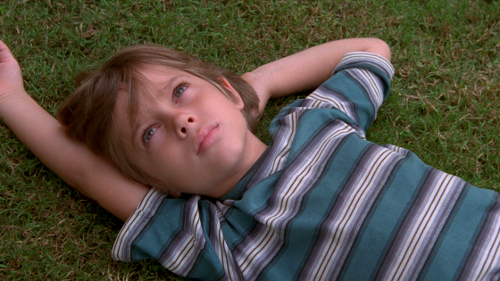
Ellar Coltrane as Mason at the beginning of Boyhood
This repost by Robin Hitchcock appears as part of our theme week on the Academy Awards.
Let’s face it, Boyhood is a gimmick movie. Richard Linklater sporadically filmed it over a 12-year period so we could see the child actors in it actually grow up. If you loved Michael Apted’s Up series but wanted more fiction and less wait, Boyhood is for you. But if you just love coming-of-age dramas, I’m not sure I can recommend this one.
The child actors (Ellar Coltrane as central character Mason and the director’s daughter, Lorelai Linklater, as Mason’s sister, Samantha) are extremely natural and sufficiently likable. Patricia Arquette is fantastic as their mother, who faces a roller coaster of personal, professional, and economic ups and downs. And Ethan Hawke plays their intermittently available father as Ethan-Hawke-in-a-Richard-Linklater-movie, that is, opinionated and rambling and just-barely functioning as an adult human being, but I happen to like that character a lot.
Mason and Samantha’s mother (Patricia Arquette) reads them a Harry Potter book
As strong as their performances are, the problem is that Patricia Arquette and Ethan Hawke are recognizable movie stars, in stark contrast with the kids at the center of the film and the unknown Texan character actors in the supporting cast. This evaporates the faux-documentary feeling of Boyhood, and leaves in its place an overlong, meandering, plain-old movie.
What’s left is essentially the non-dinosaur, non-Sean Penn-on-limbo-beach parts of The Tree of Life, with fewer shots of light shining through trees, and nostalgia from the last decade instead of the 1950s. Six-year-old Mason rides his bike in endless loops around his block. Eight-year-old Mason plays Wii boxing. Twelve-year-old Mason finds out about internet porn. Fifteen-year-old Mason smokes weed and gets an earring. Seventeen-year-old Mason has sex with his girlfriend in his sister’s dorm room. Eighteen-year-old Mason wins a photography scholarship and does shrooms in the mountains and we can finally, FINALLY leave the theater. (Boyhood is two hours and 45 minutes long, with exactly zero explosions or giant robot fights. I do not have the patience for such things.)
Mason and his sister Samantha (Lorelai Linklater)
It is possible I lost interest because I never had a boyhood of my own. I kept wanted to see more of Samantha, because I could relate to her girlhood (my favorite scene in the movie was Samantha cringing through The Sex Talk with her dad at a bowling alley) and get my nostalgia kick. I was also more interested in Patricia Arquette’s mother character and her struggles because I could relate to them as an adult and as someone who plans to have children.
Sullen teenage Mason and his father (Ethan Hawke)
I may be placing too much importance on gender here, because there are loads of non-gendered experiences of childhood present in this movie. I played with dirt and found out my parents aren’t perfect and rejected authority figures and aggressively sulked, just like Mason. Maybe if Samantha and the mother hadn’t been there, just out of focus, I would have related more to his journey instead of yearning for more from the sidelined female characters.
And as I got bored with Boyhood, I got distracted by the logistics of its gimmick. The passage of time is largely expressed through changed hairstyles on the kids, and I wondered if that was mandated by the director (would Richard Linklater really make his daughter get a regrettable purple-red dye job? (ETA: he did not.) I morbidly wondered what kind of insurance they took out on the lives of the central actors and how they would have reacted to an untimely death. I tried to remember what year the songs on the soundtrack came out so I could figure out how much longer I had to wait to get out of there (I have never been so excited to hear that Gotye song. I turned to my viewing partner and whispered “only two years left!!”).
Eighteen-year-old Mason at the end of the film
Boyhood is a gimmick movie, but admittedly, the gimmick is pretty cool. If you don’t mind long runtimes and have a strong way to relate to this disjointed series of vignettes (having had a boyhood of your own, having a son around the age of the kids in the movie, growing up in Texas), you may well love Boyhood. I didn’t hate it. I just wanted to see more of the women in it and have it be over an hour earlier. My own childhood felt shorter.
Robin Hitchcock is an American writer living in Cape Town who still plays with sticks in the dirt.
In so many ways, this film reflects the current moment, while also highlighting how things have and have not changed since the King family and their allies risked their lives to secure rights for all. Scenes in the film will jolt you into the present: watching Jimmie Lee Jackson’s mother grieve in 1965 for the son she will never see again made me immediately think of the family of Tamir Rice, the young black boy who was murdered by police officers this year for toting a toy gun in Ohio. ‘Selma’ is now.
This repost by Nijla Mu’min appears as part of our theme week on the Academy Awards.
Historical dramas often stick to a tried-and-true formula: Important figures face struggles, then they triumph, becoming the great people we know today. We can usually count on a scene from their conflicted childhood, scenes showing their romantic troubles, any issues with drugs or alcohol, and how they persevered through it all to deliver whatever divine message or artistic gift they possessed.
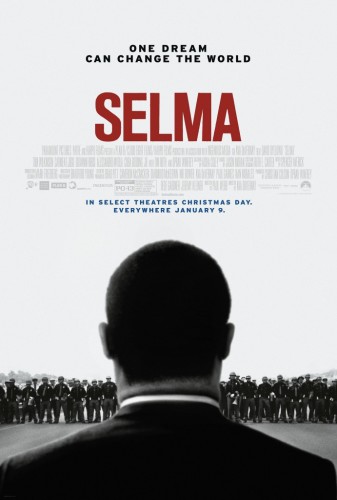
Ava DuVernay’s new Martin Luther King Jr. biopic, Selma, avoids this formula—much to its benefit. It is one of the most effective, well-crafted historical biopics that I’ve ever seen because it goes off the traditional narrative about the Civil Rights Movement, giving us a moment in history that feels immediately familiar to the moment we are currently living in.
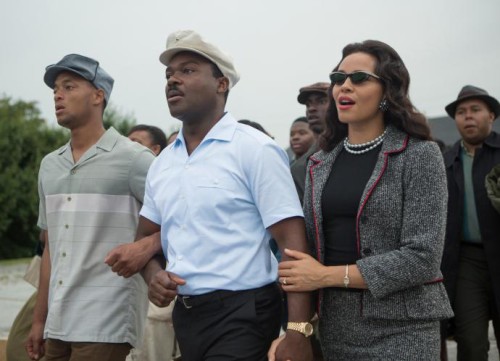
Selma captures the tireless efforts of Martin Luther King Jr. and a group of black activists attempting to secure equal voting rights for black people. These efforts led to the passage of the 1965 Voting Rights Act, signed into law by President Lyndon B. Johnson. The film takes its name from the series of marches that King and his followers embarked on at the Edmund Pettus Bridge in Selma, Alabama. One of those marches was infamously known as “Bloody Sunday,” after police and deputized locals descended on the protesters with nightsticks and tear gas. DuVernay and Director of Photography Bradford Young capture that march in all its terror in a scene where young and elderly marchers are clubbed and chased by angry police on horses. Selma certainly doesn’t cast the history of the Civil Rights Movement in feel-good soft focus.
In a recent interview I conducted with DuVernay, she discussed the way she approached the humanity of Dr. Martin Luther King Jr., including his suspected infidelity. She was most interested in how this information affected his wife, Coretta Scott King, and how Martin Luther King would respond in the moment when questioned by Coretta. This emphasis on the intimacy in their relationship, rather than the scandal that the FBI sought to publicize, is something that informs the core of the film.
DuVernay is not interested in showing us montages of the unfaithful hero, his mistress, and the scorned wife, as was done in Mandela: Long Walk to Freedom. She is interested in the complex spaces of love and pain between two people. Coretta Scott King, played with an uncanny resemblance by Carmen Ejogo, takes on a central role in this film, not only as a wife and mother, but as a key player in the movement as she faces daily death threats made against her and her family. The attention and specificity paid to her character and her relationship to King is another gift that DuVernay brings to this film.
Further, there are so many ways this film could’ve become an extension of the Hallmark image that we see of Martin Luther King Jr., one that replays the same “I Have a Dream Speech” and tells us that nonviolence is the only way. While those elements are important, they are often overemphasized at the expense of the other work he did.
That is where Selma fills in the blanks. In this film, we get to know a methodical, intelligent, human Martin Luther King Jr; a man who just wanted to sit down at the end of the day and smoke a cigarette, or call Mahalia Jackson in the middle of the night to hear her sing a soothing gospel song. In the film, he invokes nonviolence but also cleverly provokes outward hatred in his opponents, helping people around the world witness this physical racism in the media. His tactics were risky, his negotiations with the likes of LBJ were grueling, and he was often put in positions of extreme discomfort, along with the many people he worked with.
This is not a film about a man and his followers, but about how a man’s work is informed by the respect he has for the people he works with—and even those he doesn’t. It reflects the movement by emphasizing distinct traits in each of the civil rights leaders it documents, from the youthful resistance of Jimmie Lee Jackson (played powerfully by Keith Stanfield), to the gentle persistence of Malcolm X (Nigel Thatch), who appeals to Coretta Scott King in a beautifully rendered scene. That scene and others completely reverse the rhetoric we’ve been fed about who these people were. The warring ideals between Malcolm and Martin aren’t the focus of this narrative, but rather how Malcolm X may have actually intentionally pushed many black people to follow Martin Luther King Jr., helping to strengthen the movement after all. Again, DuVernay utilized Coretta Scott King in a way that shows her role in the movement beyond being a supportive wife. She serves as a sort of peacemaker here.
In so many ways, this film reflects the current moment, while also highlighting how things have and have not changed since the King family and their allies risked their lives to secure rights for all. Scenes in the film will jolt you into the present: watching Jimmie Lee Jackson’s mother grieve in 1965 for the son she will never see again made me immediately think of the family of Tamir Rice, the young black boy who was murdered by police officers this year for toting a toy gun in Ohio. Selma is now. It lets us into the interior spaces of pain, progress, and movement that no formulaic historical drama could ever capture.
Selma opened Christmas Day in Los Angeles, New York City, Washington, DC, and Atlanta. It opens nationwide Jan. 9.
DuVernay has said in interviews that when she inherited Paul Webb’s screenplay, she altered it to decenter its focus on President Lyndon B. Johnson (even though the controversy surrounding the film managed to once again re-center the story on white male power and its portrayal). Rather than criticize the director for shifting her gaze away from whiteness (or for getting certain historical details wrong), it may be more useful to consider the difference a woman behind the camera—and a Black woman in particular—brings to a motion picture.
This repost by Janell Hobson appears as part of our theme week on the Academy Awards.
Last year was a stellar one for Black women filmmakers. First, there was Amma Asante’s exquisitely filmed Belle (starring an impressive Gugu Mbatha-Raw), followed later by Gina Prince-Bythewood’s emotionally layered Beyond the Lights (also starring Mbatha-Raw). The year finally closed out with Ava DuVernay’s critically acclaimed historical drama, Selma.
However, while Belle was summarily dismissed by movie critics as a “black Jane Austen drama,” and Beyond the Lights received more favorable reviews but was nonetheless ignored at the box office, DuVernay has a real shot at becoming the first Black woman to be nominated for a Best Director Oscar (having already made history with her nomination at the Golden Globes). Of course, there is something to be said for women receiving critical acclaim when the films they direct focus on the lives of men, but that’s another story. Nonetheless, the acclaim she has received is absolutely earned.
Selma is a rather subversive take on historical events: part sweeping epic drama, part intimate and domestic storytelling in its rendering of the voting rights march from Selma to Montgomery, Alabama in 1965 (led by Dr. Martin Luther King, Jr. and played in the film with an understated grace by David Oyelowo). DuVernay imbues this Civil Rights-era film with a black woman’s sensibility, which makes the storytelling all the richer.
There is the opening shot, featuring King practicing his acceptance speech for the Nobel Peace Prize, before he is joined by his wife Coretta (played by Carmen Ejogo in an uncanny resemblance to the late icon) fixing his tie. Here, an international milestone is seamlessly intertwined with the space of domestic intimacy, just as the following scene depicting the four girls in Birmingham decked out in their finest Sunday best—as they gossip about how Coretta Scott King does her hair while descending into a church basement—resonates on the most mundane level. Although we have the benefit of history, it is still jarring when the bomb explodes, and, as occurs throughout the film, each death is doled out in slow motion, the camera (aesthetically positioned by the accomplished cinematographer Bradford Young to capture the brilliance of dark skin) refusing to turn our collective eyes away from the bloodshed and the casualties of “racial progress.”
DuVernay has said in interviews that when she inherited Paul Webb’s screenplay, she altered it to decenter its focus on President Lyndon B. Johnson (even though the controversy surrounding the film managed to once again re-center the story on white male power and its portrayal). Rather than criticize the director for shifting her gaze away from whiteness (or for getting certain historical details wrong), it may be more useful to consider the difference a woman behind the camera—and a Black woman in particular—brings to a motion picture. Because of the rewrite, we not only get a redirection on King and how his Southern Christian Leadership Conference group came into conflict with the younger Student Nonviolent Coordinating Committee, but women are also added to the picture, including movement participants like Freedom Rider Diane Nash (played by Tessa Thompson), Amelia Boynton (Lorraine Touissant) and Annie Lee Cooper (Oprah Winfrey). They are still marginal to the main story, but at least they are visible and part of the grassroots movement critical to King’s leadership.
We also see certain feminist approaches: from how the movement men can descend onto a woman’s home and make themselves quite comfortable as their very masculine dominance takes over her kitchen space (a subtle critique of the ways progressive men constantly rely on and exploit women’s labor, all wrapped up in the warmth of black Southern domestic comfort) to a scene featuring Amelia Boynton and Coretta Scott King discussing the struggles of activism and the challenge of maintaining hope (a scene Touissant has noted was DuVernay’s own conscious attempts at passing the Bechdel Test by including a scene where women are not talking about men). Through Coretta’s story, DuVernay also highlights how the iconic hero that we celebrate through King does not translate to admirable husband and father. King’s infidelities, however, are included not to tarnish his image but to undergird the real difficulties of committing to both a political movement and the personal sphere. King’s political involvement (including long stays away from home) also brings the constant fear of death, a fear Coretta quietly yet persistently underscores throughout her scenes.
More than anything, Selma is what we get when we intersect the personal with the political, the epic with the intimate, the historical with the present day (e.g. because King’s speeches were off limits, what we also get in the film are double entendres of what the Selma movement meant for 1965 and what present-day struggles mean for us here in 2015).
While the film’s budget is tiny by Hollywood standards ($20 million), what DuVernay does with the film is a real triumph in not only quality filmmaking but in accomplished storytelling, where black people and their allies stand in all their brilliant humanity and where women’s stories hold equal weight against the heavyweight often accorded men’s histories. Let us hope her triumphs will open the doors wider for other women filmmakers.
Of course we may find solace on smaller screens, where diversity reigns and where Shonda Rhimes dominates Thursday television with her Black women leads and multiracial casting. Nonetheless, there is a power that is felt when viewing images in a much larger medium with its expansive and colossal screen and booming soundtrack. DuVernay has shown why Black women still matter on big screens and why they matter more so behind the camera.
Do great women exist? The film industry still hasn’t decided. We had ‘Frida’ a dozen years ago and that bio-pic about Margaret Thatcher (like ‘Frida,’ directed by a woman) from a few years back–which won Meryl Streep an Oscar, but tepid reviews along with a completely irredeemable main character kept me from seeing it. Usually the women in the “great man” films are great only by osmosis, because they married or otherwise provide emotional–and other–support to great men. The actresses who play these roles win Oscars too: they make the “supporting” category a literal one. ‘The Theory of Everything,’ the new bio-pic about astrophysicist (and best-selling author) Stephen Hawking seemed like it might be different since it’s based on the book written by the great man’s first wife, Jane.
This repost by Ren Jender appears as part of our theme week on the Academy Awards.
Like a lot of women, I’m impatient with the “great man” films that invade theaters every year just in time for Oscar consideration. The main character is always a man whose name we all know, played by an actor who really wants an Academy Award. We see his earliest struggles then later, his triumphs. The addition of some failures never succeeds in making the film more interesting, just longer.
Do great women exist? The film industry still hasn’t decided. We had Frida a dozen years ago and that bio-pic about Margaret Thatcher (like Frida, directed by a woman) from a few years back–which won Meryl Streep an Oscar, but tepid reviews along with a completely irredeemable main character kept me from seeing it. Usually the women in the “great man” films are great only by osmosis, because they married or otherwise provide emotional–and other–support to great men. The actresses who play these roles win Oscars too; they make the “supporting” category a literal one. The Theory of Everything, the new bio-pic about astrophysicist (and best-selling author) Stephen Hawking, seemed like it might be different since it’s based on the book written by the great man’s first wife, Jane.
But the movie begins by focusing on him (Eddie Redmayne) not her, as he rides a bike, attends classes as a Ph.D. student in the early 1960s at Cambridge and acts as a coxswain (complete with megaphone) for the crew rowing on the river. Hawking meets Jane (Felicity Jones) at a student mixer and they become a couple. Hawking’s physical awkwardness could pass for that of any geeky man who considers his body merely a container for his brain, but we know what’s coming before the characters do when we see scenes in which Hawking trips and falls in a train station or his hand folds in on itself as he writes equations on a blackboard. When he has a fall in the yard he receives his diagnosis, ALS (also known as Lou Gehrig’s Disease), along with the news “Life expectancy is two years.”
At first he avoids Jane and holes up in his room, but after she finds out from his friends about his illness, in a scene we’ve all watched in countless other films, she marches into his room and declares, “I want us to be together for as long as we’ve got.” Stephen resumes his studies and for his thesis topic chooses “time.” He and Jane get married and start to have children soon after.
What follows is a portrait of a marriage that combines all the elements of pre-second-wave feminism at once: Jane has to set aside her studies not just to care for her very young children, to make all the meals and clean the house, but also to care for her husband, whose mobility is rapidly deteriorating, even though he’s still a relatively young adult. At the point where he can walk only with the assistance of two canes and can maneuver the stairs in his house only by lying flat on his back and grasping with his few remaining functional fingers the railing to pull himself up or down, we see Stephen hand in a typed dissertation with a barely legible shaky signature; I couldn’t help wondering if the person who typed it was Jane, since he seems unlikely to have been able to do so himself–and so many wives in that era were also their husbands’ de facto secretaries. We’re also seeing an era in which care for disabled family members was often left to a wife or mother (as opposed to paid staff, unless the family was very wealthy), and no one, not Hawking’s family nor Jane’s, ever thinks of taking over his care for even a few hours at a time to give Jane some respite. On the drive back from a dinner at his family’s hillside cottage in the country, a teary Jane tells Hawking she needs help, but he cuts off any further discussion.
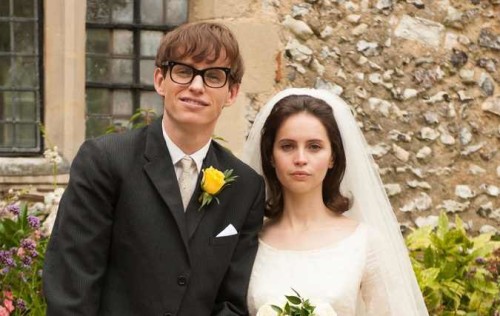
Eddie Redmayne as Stephen Hawking and Felicity Jones as Jane Hawking
Later Jane’s mother can see how stressed she is and (instead of offering to help) suggests she join a church choir (Jane is a regular churchgoer, a contrast to her outspoken, atheist husband). She then meets the handsome choirmaster, Jonathan (Charlie Cox) who becomes a family friend and also helps with Stephen’s care. Stephen seems to see the spark between his wife and Jonathan from the beginning and lets her know in an indirect way that she is free to pursue the relationship. Here the film is at its most interesting: too many “great man” films seem to sum up the wife or girlfriend character struggle of living with the great man as “she was a saint” without considering that she might have needs of her own. Jane’s situation also parallels many others of the 50s and 60s when women got married in their early 20s and found in their 30s and 40s their marriages did not fulfill their own expectations and ambitions. Jane remains devoted to Stephen but is at her happiest when she spends time with Jonathan. The closeness of their relationship invites the scrutiny of others at the christening of her third child, when her mother-in-law follows her into the kitchen and declares the family has a “right to know” whether the child is Jonathan’s. Jane replies that the child’s father could not be anyone but Stephen.
When Stephen has the health crisis that robs him of the ability to talk without assistance, Jonathan steps back and nurses come into the home to help Stephen, along with a man who designs a device through which Stephen can talk again, by slowly “typing” (actually clicking a monitor to choose letters and phrases) and having an electronic voice read the words. Stephen becomes very close to one nurse in particular, Elaine (Maxine Peake), who even helps him to look through the copies of Penthouse that come to his office. He eventually leaves Jane for her. An end title tells us that Jane eventually got her Ph.D., married Jonathan, and that she and Stephen are still friends.
Jane watches Stephen “speak” through a device while the woman who will be his second wife looks on.
What the film leaves out are the most interesting parts of the story–not just Hawking’s scientific work (we get explanations that are so oversimplified they don’t make much sense), but also that the nurse Stephen lived with (and eventually married and divorced) was the wife of the man who created his speaking device–and that she was also investigated after other caregivers alleged she physically abused Stephen (during their relationship he had unexplained bruises, broken bones and burns). When Jane did publicity for a previous movie based on her and Stephen’s relationship, she said she couldn’t comment on Elaine (who was still married to Stephen then) for legal reasons. She did admit during interviews that she was friends with Stephen mainly for the sake of the children. And she and Stephen weren’t a couple when he was diagnosed, their romance blossomed afterward, which Jane described as being in keeping with the great optimism of the early 1960s that ran parallel with the belief that nuclear war between the super powers could, at any moment, wipe out the world.
Redmayne does a credible job as Hawking (whose character in the film is much more sympathetic than Jane and news sources have portrayed him; this Hawking never runs over anyone’s toes “accidentally” with his electric wheelchair), especially in the later scenes where we see a certain impishness in his face (very like the real-life Hawking’s), while most of his features remain immobile. Jones as Jane does a serviceable job too, but I wish she had been allowed to look and dress less like Jean Shrimpton (the British supermodel popular in the era when the film begins). At least Redmayne (who is also more conventionally pretty than the person he plays) gets to mess up his hair and wear unflattering glasses; Jones, for much of the film, until she starts wearing a crappy short wig and half-assed “aging” makeup, looks like she could have stepped out of a stodgy, British clothing catalogue, even when Jane has three kids and a disabled husband to take care of, and, as Jane points out in her book, and is briefly referenced in the film, very little money. The filmmakers (screenwriter Anthony McCarten and director James Marsh) didn’t seem to think any of these details were worth including. The Theory of Everything is a good, if very conventional, film, but the real story it’s based on could have been made into a great one.
Sometimes I wish the mainstream film industry would stop making movies about queers. The rare times that a queer person is allowed to be the main character in one of its movies, as in this one, he (almost always a “he”), like the rare main character of color is usually unrealistically isolated from the community he comes from, a trope fostered from before Stonewall to the ’90s to now: we are oh-so-tragic and oh-so-alone.
This repost by Ren Jender appears as part of our theme week on the Academy Awards.
A stereotype in popular media about very smart people is that they must have some great deficiency in other areas of their lives–as if someone with extraordinary intelligence being able to make friends and get laid would be unfair to the rest of us. The only reason I can surmise for the positive reviews The Imitation Game, a highly fictionalized new film about gay, World War II codebreaker Alan Turing is that it confirms all the “normal” audience’s worst suspicions about “genius” and queer life, without offering any meaningful insight into either.
Sometimes I wish the mainstream film industry would stop making movies about queers. The rare times that a queer person is allowed to be the main character in one of its movies, as in this one, he (almost always a “he”), like the rare main character of color is usually unrealistically isolated from the community he comes from, a trope fostered from before Stonewallto the ’90s to now: we are oh-so-tragic and oh-so-alone. Because he has no peers to rely on, the main gay guy invariably confides in the straight guy (particularly ridiculous in The Imitation Game’s 1940s setting) just like in movies set in the Civil Rights-era South, Black people have all their deepest conversations–and bonds–with white people. When a film shows the rare group of people of color relying on each other, as in Selma, awards snub it and prominent white guys denounce it. When a film like the underrated Pride shows a group of queers working together, the blurb on the back of the DVD makes sure it doesn’t offend any “Christian values” by mentioning something as crass as LGBT identity.
“Homosexuals”–as they were known then–could be arrested during the time the film takes place (as Turing was after the war, one of the few parts of the film that isn’t doctored) and imprisoned both in England and elsewhere, but that didn’t stop them from existing or having sex with each other–and straight people knew them even if they didn’t acknowledge that they did. World War II was a vehicle for many queers from the US (and probably those in the UK too) to find each other, no longer isolated in their small hometowns. But even before the war, academia (where Turing came from) was, notoriously, also a refuge for gay men. The arts were another. Accounts from those who knew him say that Turing was quite open about his sexuality (instead of the anguished confessions we see here): and then, as now, straight people (and I’m presuming most of the people interviewed were straight) were always the last to know. Also unchanged in the intervening years: the rules for men in power or ones with powerful friends were different: actor John Gielgud was arrested in the same time period as Turing was for having sex with another man, but faced neither imprisonment nor the forced hormone treatment Turing accepted instead of a prison sentence.
Joan Clarke (Keira Knightley) and the guys
All the most interesting twists of the story are the ones the film avoids. As part of the huge wartime operation at Bletchley Park Turing had helped win the war against the Nazis (in fact his team’s decryption might have been the deciding factor) but he couldn’t tell anyone about it–nor could anyone else. Some powerful people did write letters of support for him during his trial, but they couldn’t say precisely why they were writing them. If his work during the war hadn’t been secret the charges against him probably would never have come to trial–or been made in the first place.
Instead, what passes for drama in this film are pedestrian scenes that are the invention of screenwriter Graham Moore. Even though there’s no historical evidence of any such incident we get more than one sequence in which Turing’s supervisors attempt to destroy his work. “You will never understand the importance of what I’m creating here,” Benedict Cumberbatch, as Turing, cries in the first film performance I’ve seen that is best encapsulated by the phrase “the gnashing of teeth.”
These scenes might be a reflection of the vanity of its hack filmmakers (writer Moore along with director Morten Tyldum). “I’m afraid these men would only slow me down,” the film’s Turing says about the team of other codebreakers. Not only does this film leave out all the other people (including some Polish cryptologists who made a valuable prototype) who helped Turing get to the point where he could successfully design and run Bombe (not “Christopher”: the name Turing gives his codebreaking computer in the film– after his first love!) but in the film he’s also perpetually misunderstood and under-appreciated by others the same way white, male writer and director “auteurs” seem to often feel they and their own work are, even as they dismiss (and underpay) the many other people who make their films possible and enjoyable. Maybe this parallel is the reason for the spate of “great man” films and the awards they always seem to collect this time of year.
The lone woman with a decent-sized part in the film is Joan Clarke (played by Keira Knightley) Turing’s fellow cryptanalyst who becomes his friend and, for a time, is engaged to him. Unlike the ridiculous scene in the film when Turing breaks up with her, the real-life Clarke was reportedly “unfazed” when she found out her fiancé was queer, because in those days (as the film touches very briefly on) marriage was the only way for most young women to get away from the control of their parents.
And even though a big deal is made of Joan Clarke being one of the only woman cryptanalysts, like “Rosie The Riveter” stateside, 80 percent of Bletchley Park’s employees were women. The codebreakers were popularly known as “Dilly’s girls” after the (male) head of the operation, none of which is reflected in Game. Thanks for erasing the historical contributions of women again, mainstream film industry!
Another film about genius and secrets making the rounds of top ten lists and awards is Laura Poitras’s Citizenfour, the documentary about Edward Snowden, who acted as a whistleblower by releasing evidence of the US’s widespread and unconstitutional spying on its own citizens.
You’d never know from the many news accounts about Snowden that Poitras was the first person he made real contact with when he decided to go public. Poitras reads his first message aloud on the soundtrack, “Laura, at this stage I can offer nothing more than my word. I am a senior government employee in the intelligence community. I hope that you understand that contacting you is extremely high-risk.”
The film makes clear, hilariously, that when Snowden first tried to get in touch with Glenn Greenwald, who is usually given the credit for bringing Snowden’s story to the rest of the world, Greenwald couldn’t learn to use the encryption Snowden (who knew how volatile this information was) insisted on, so Snowden moved on to Poitras (who was well-versed in encryption after the government had seized footage from her previous documentaries, including one about the Iraq war). After a time Snowden suggesting that she bring in Greenwald–when presumably she could instruct him what he needed to do to get his encryption skills up to snuff.
Citizenfour, I had to keep reminding myself, shows us history in the making. We meet Snowden before his first media interview. We see him in the hotel room in Hong Kong where he was first holed up when the story broke. I had to keep telling myself what I was seeing was important because most of it is otherwise pretty dull.
Filmmaker Laura Poitras
We never find out much about Snowden beyond what we’ve seen in other media. He is a man who is preternaturally sure and calm about what he’s done, perhaps because, as an autodidact (he has a GED) at the top of a highly skilled field, he was able to think for himself on the implications of the work he was being asked to do.
We do see the travails of another whistleblower who went through more traditional channels and is still suffering blowback for it, to show us why Snowden released the info to the media directly. And we see Snowden upset at how the girlfriend he lived with and left behind in Hawaii is treated by the government in his absence. But as a friend remarked as we left the theater, “Watching Edward Snowden stare at his laptop isn’t very exciting.”
Although Snowden was sure he would be tried and imprisoned for his actions, saying in one of his preliminary messages to Poitras, “In the end if you publish the source material I will likely be immediately implicated,” he eventually saw that he could, with help, escape and chose to do so. But the scenes that should build up tension and our empathy for him (even those of us who admire his actions and sympathize with his plight) fall flat.
An exception is when we see Snowden’s face on video blown up to epic proportions in a main Hong Kong Square, just after his first big media interview, and then cut back to Snowden still in his hotel room, trying to change his appearance so he won’t be recognized (and abducted) on his way to the airport. Otherwise we don’t feel like we are in Snowden’s shoes in this film, even as we spend much of our time looking and listening to him. At the end we see Snowden has reunited with his girlfriend in Russia (where he has been trapped since the US government cancelled his passport–just before he could catch the second leg of his escape flight). We see them through a window, preparing dinner together, from a distance, an apt metaphor for how well we have come to know Snowden in this film ostensibly about him.
Arquette, who is terrific as Olivia, turns in a nuanced and complex performance that is vanity free. We watch her age perceptively and slowly as her character gains wisdom but still falters. In other words, she’s the kind of three-dimensional woman we rarely see in American films.
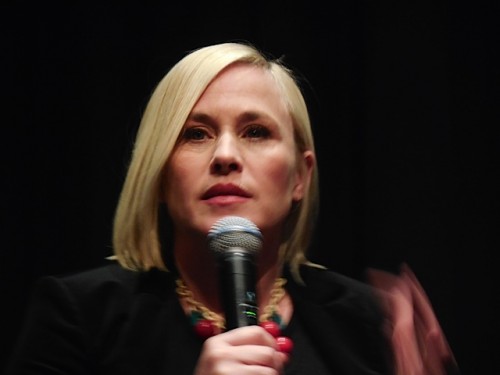
Patricia Arquette
This repost by Paula Schwartz appears as part of our theme week on the Academy Awards.
The stars of Richard Linklater’s Boyhood–Patricia Arquette, Ethan Hawke, and Ellar Coltrane–age in real time in this one-of-a-kind nearly three-hour film. Boyhood, which was shot in short annual increments over a dozen years so the effect as you watch the actors change imperceptibly and slowly is like watching time-lapse photography.
This approach would come across as a gimmick or stunt if the movie wasn’t so good. The real magic of the film is that as you watch characters grow and age, you can’t help looking back and contemplating your own life changes.
The three stars and the director of Boyhood participated at a lively press conference recently at the Crosby Hotel in SoHo to promote the film. This marks Ethan Hawke’s eighth film with the director, whose most notable collaborations include the Before Sunrise trilogy and Dazed and Confused (1993).
Boyhood tracks the life of a full-faced pouty six-year-old, Mason (Coltrane) and his older, bratty sister, Samantha, played by Lorelei Linklater, the director’s daughter, as they grow up and mature. The story focuses on Coltrane’s character who evolves from boyhood to early manhood amid personal and family dramas, including family moves, family controversies, faltering marriages and re-marriages, new schools, first and lost loves, and good and bad times. Children of divorce, Mason and Samantha are raised by their beleaguered but devoted mother Olivia (Arquette), a hard-working woman with terrible taste in men, and her ex-husband, an immature man with a good heart but little sense of responsibility (Hawke).
Linklater described Boyhood as “this little collection of intimate moments that probably don’t fit into most movies. They’re not advancing the character enough or the story enough or the plot, but they all add up to something much bigger than each little place and each little piece of it, so that was kind of the feel to the whole movie, that it mirrors our lives.”
As to whether the film was an intimate character study or a sweeping family epic, the director said it was both. “It’s very specific and intimate but universal within that specific world. It could have been made in any country and any time. There’s such a commonality here.”
The cast and director of Boyhood
The film could just as accurately been entitled Motherhood or Fatherhood or Parenthood, Hawke said. He described it as “an epic about minutiae. That’s what it is. It’s difficult to title because of that. It’s a family seen through one boy’s eyes, so that title makes as much sense as any other.”
As for whether it was difficult for the actors to get back in character every year for the brief period they shot their roles, Coltrane explained, “It was a very long build up every year. We’d have a couple months to think about what we were doing and then a solid week of kind of work shopping and building the character and figuring out where the characters were that year, so by the time we got to filming we were kind of just already there.”
Arquette, who is terrific as Olivia, turns in a nuanced and complex performance that is vanity free. We watch her age perceptively and slowly as her character gains wisdom but still falters. In other words, she’s the kind of three-dimensional woman we rarely see in American films.
Hawke turned to Arquette during the press conference and told her, “I’m just throwing props your way. I’m surprised that people don’t write about more is that how awesome it is to see Patricia’s character be in this movie and to see a real woman who is a mother and a lover and more than one thing in a movie. I feel so proud to be a part of a movie that respects her character the way this movie does, and I feel it’s also sometimes so real and so true that you almost don’t ever see this in film,” he said. “It’s true in life. We see it all the time, but I don’t see that woman in movies. I don’t see her.”
“She’s in the background or just kind of in the background or ancillary elements to give some encouragement in some way to some scruffy guy. Olivia is a real, three-dimensional human being, and it was so exciting, and the women in my life who see the movie so appreciate it,” he said. ” She’s not just good, she does stupid things and smart things.”
He added, ” I just love her. You can’t pin down. One minute you go, oh she’s a good mother! No, wait, actually that was not a great decision. We’re used to people in movies being one thing, all the time.”
Arquette explained her acting technique. “In acting you have to get past your own head and your own ego and all of these fucking barriers and walls to just get to a place where hopefully you can be present enough in a scene with someone.” She added of the collaborative process, “I trusted the process. It was jumping into the void from the get-go, but when you’re in the right hands, and you jump into the void together, really great things can come of it.”
Patricia Arquette and Ethan Hawke
Ultimately, the director said, the movie “was always going to be a portrait of growing up but also parenting and aging. That you don’t quit growing up, especially once you’re a parent.” Hawke and Arquette’s characters are bumbling through parenting as this was happening in real life with the actors and director. “We had ourselves as parents,” Linklater said. “During this film we had five children born between us and that was just an ongoing part of life.” At the same time, “ You’re thinking of your parents once you’re a parent yourself.”
The movie mirrored what was happening in the lives of the actors and director. “We didn’t want anything to feel like it wasn’t earned or tethered to some sort of reality. I don’t think there’s anything in the movie that didn’t come out of my life or their lives,” Linklater said. His hope was that the film opened the audience up to the possibility of seeing the connection between their lives and that of the characters in the film. “Once you get to this thinking about life in general and your own life and loved ones and your own experiences, triggering all kinds of wonderful things I hope, painful and wonderful things.”
Paula Schwartz is a veteran journalist who worked at the New York Times for three decades. For five years she was the Baguette for the New York Times movie awards blog Carpetbaggers. Before that she worked on the New York Times night life column, Boldface, where she covered the celebrity beat. She endured a poke in the ribs by Elijah Wood’s publicist, was ejected from a party by Michael Douglas’s flak after he didn’t appreciate what she wrote, and endured numerous other indignities to get a story. More happily she interviewed major actors and directors–all of whom were good company and extremely kind–including Brad Pitt, Angelina Jolie, Morgan Freeman, Clint Eastwood, Christopher Plummer, Dustin Hoffman and the hammy pooch “Uggie” from “The Artist.” Her idea of heaven is watching at least three movies in a row with an appreciative audience that’s not texting. Her work has appeared in Moviemaker, more.com, showbiz411 and reelifewithjane.com.
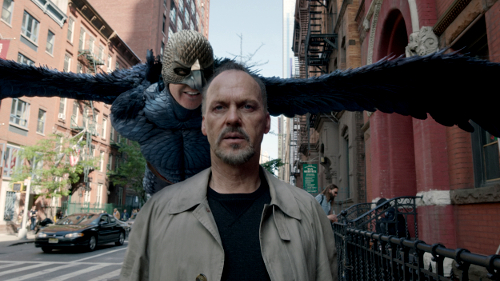
‘Birdman’ bears striking similarities to ‘Black Swan,’ both in the broad strokes—each follow their protagonist’s slipping grip on sanity in the days before a high pressure stage debut—and in a strange number of superficial details—hallucinations of menacing black winged creatures, “surprise” lesbian scenes, and ambiguous suicides at least partially showcased on stage.
Michael Keaton in Birdman
This repost by Robin Hitchcock appears as part of our theme week on the Academy Awards.
This review contains spoilers for both Birdman and Black Swan.
Alejandro González Iñárritu’s new film Birdman or (The Unexpected Virtue of Ignorance) bears striking similarities to Darren Aronofsky’s 2010 film Black Swan, both in the broad strokes—each follow their protagonist’s slipping grip on sanity in the days before a high pressure stage debut—and in a strange number of superficial details—hallucinations of menacing black winged creatures, “surprise” lesbian scenes, and ambiguous suicides at least partially showcased on stage. Of course, these two films differ in many ways, most significantly in tone (Birdman is a black comedy, Black Swan is a chilling psychodrama if not an outright horror movie). It is in these departures that we see the significance of gender in stories about identity, art, and mental illness.
1. Phase of life
Riggan in front of his dressing room mirror in Birdman
Birdman‘s Riggan Thomson is a fading movie star, years after playing the title character in a series of superhero blockbusters (casting Michael Keaton in the role deepens the character tenfold). The play at the center of the film is his own adaptation of Raymond Chandler’s What We Talk About When We Talk About Love, which he is also directing and starring in. This vanity project is Riggan’s hope to change his legacy, to transform from the kind of has-been actor who gets attention from tourists to the kind of eternally relevant artist who gets respect from theatre critics.
Nina in front of a mirror in Black Swan
Where Riggan is in the twilight of his career, Black Swan shows Nina Sayers is at the dawn of hers, as she ascends from the corps to play the Swan Queen in Swan Lake. Nina’s transformation over the course of the film is partially a metaphor for her belated sexual awakening and maturation from girl to woman. This becoming is the crucial moment in Nina’s life; she will never face Riggan’s struggle to stay relevant. As we see from the prima ballerina Nina replaces, Winona Ryder’s Beth Turner, there is no option to age gracefully. This is why, even as Nina apparently dies at the end of the film, it is “perfect.”
2. Perfection vs. Superpowers
Riggan’s first appears in Birdman, impossibly levitating
It is the pressure to be perfect that pulls Nina apart in Black Swan. Not only the physical rigors and intense competition of professional ballet, but the paradoxical obligations of womanhood as represented through her dual role as the Swan Queen and Black Swan. But Riggan doesn’t want to be perfect, he wants to be exceptional. His delusions of his superhuman abilities are his way of reassuring himself that his existence is noteworthy, that he matters, that he deserves to be remembered.
Nina finds herself sprouting feathers
Nina hallucinates body horrors and birdlike transformations reminding her of the separation between her human self and the perfection required for her role. Riggan has easily incorporated superhuman abilities into his sense of self. As a man, he is entitled to do so. Nina’s are horrific transformations as she loses her sense of self.
3. Rivals
Mila Kunis as Lily in Black Swan
Although early marketing for Black Swan played up the “rivalry” between Nina and Mila Kunis’s Lily, Lily is not so important to the plot as she is a character foil for Nina. Lily represents the raw sexuality and effortless grace that Nina’s drive for perfection precludes her from acheiving. Lily is the Natural Beauty, the girl who can eat hamburgers and stay ballerina slim, party all night and still be perky and gorgeous in the morning, who you’ll never see touching up her lipstick but she’ll always have a perfect glossy pout. No matter how hard Nina works, she’ll never best Lily, because she’s less than her just by having to work for it at all.
Edward Norton as the difficult Method actor Mike Shiner in Birdman
In Birdman, Riggan’s “rival” is a hotshot actor named Mike Shiner (Edward Norton), even though he is known to be difficult to work with. Mike, a rigorous method actor, is the opposite of Lily: his talent comes from his dedication to his craft. And it is Mike’s well-honed skills that make him threatening to Riggan, who landed his career through charisma, good looks, and luck. That’s not the fame Riggan wants. It is the fame of a woman, and he knows he cannot carry it into old age and beyond (see Beth Turner). As a man, Riggan is not only allowed to “work for” his success, he even more respectable for doing so.
Just before opening night, Riggan faces off with theatre critic Tabitha Dickinson (Lindsay Duncan), who resents a movie star for taking up Broadway stage space that could go to a real artist. Riggan throws back the usual barbs against critics labeling art without making it: “None of it costs you anything. You risk nothing.” Putting on the airs of the hardworking artist he knows he is not, Riggan sounds just like someone denying their male privilege played any role in their success. Because achieved greatness is the highest virtue for a man.
4. Conclusions (the films’, and mine)
Both Birdman and Black Swan end ambiguously, with their protagonists appearing to die by suicide. In Black Swan, we see Nina’s apparent murder of Lily was not real, and that Nina rather stabbed herself. At that point in the film we’re neck deep in duality symbolism and pretty much all accept Nina attacking herself with a shard of mirror glass is a metaphor for killing the innocent side of herself, especially because girlfriend is one heck of a dancer for a stab victim. But in the final moments first Lily, then director Thomas and the other dancers also see the wound and the audience is left thinking Nina’s suicide must have been real. Because, as I mentioned before, dying after a brilliant debut performance is actually perfect for Nina, because she has nowhere higher to go from there.
Nina’s apparent suicide in Black Swan
In Birdman, Riggan first attempts suicide by replacing a prop gun with a loaded pistol on stage. Apparently, he only shoots off his nose (earning him a superhero’s face mask of bandages). Then, after hearing Tabitha gave him a glowing review and finding personal resolution with his estranged ex-wife, his best friend, and his troubled daughter, he leaps from his hospital room window. When his daughter Sam (Emma Stone) returns to his empty hospital room with an open window, we see her horrified realization that her father probably jumped. But when she looks down to the street level, she appears confused. Then she looks up, to the sky, and her face fills with wonderment. There’s ambiguous hope where Black Swan offers only ambiguous despair. Even in the darkest interpretation, that Riggan actually killed himself on stage and these final scenes aren’t real, we see that Riggan has successfully circumvented his fade to mediocrity. He “wins” in a way that Nina never could.
The more hopefully ambiguous final moment of Birdman
Looking at Birdman and Black Swan as two versions of the same story highlight the immense differences men and women face in life and in art, in expectation and in reality. It is in large part the significance of gender that makes these two movies that seem to have so much in common ultimately turn out to be quite different.
Robin Hitchcock is an American writer living in Cape Town who cannot fly nor grow feathers.
Only one of the Best Actress nominations is from one of the Best Picture nominees, whereas four of the five Best Actor nominations are for Best Picture-nominated films. As I wrote in 2013, this trend suggests that movies with significant roles for women aren’t considered as great or important by the Academy. This year, it is even worse: four of the five Best Actresses were in movies not nominated outside of the acting categories.
White hands holding Oscar statuettes.
This repost by Robin Hitchcock appears as part of our theme week on the Academy Awards.
When nominations for the 87th Academy Awards came out, I should have been on the edge of my seat. I normally completely buy into all the Oscars hype. But this awards season just hasn’t been doing it for me, and now that the Oscar noms are out the stage is set for the Boringest Academy Awards In History (or at least since that year Lord of the Rings won everything).
Honestly, the most exciting nomination to me is “Everything is Awesome” getting a nod for Best Original Song. But everything is not awesome on this nominees list:
Eight out of the nine Best Picture nominees are primarily about white dudes. Two of them are historical dramas about real life white dude geniuses.
Selma, the only Best Picture nominee about people of color, was shut out in all the other major categories (its director Ava DuVernay would have been the first Black woman nominated in the category).
Snubbed Selma director Ava DuVernay
All of the acting nominees are white.
Nominees include Whitest Man Alive Benedict Cumberbatch
There are no women nominated for best director or in either screenplay category.
Only one of the Best Actress nominations is from one of the Best Picture nominees, whereas four of the five Best Actor nominations are for Best Picture-nominated films. As I wrote in 2013, this trend suggests that movies with significant roles for women aren’t considered as great or important by the Academy. This year, it is even worse: four of the five Best Actresses were in movies not nominated outside of the acting categories.
Still Alice shut out aside from Julianne Moore’s nomination for Best Actress
Note that the one Best Actress nominee from a Best Picture nominee is Felicity Jones in The Theory of Everything, as the love interest to White Dude Genius #2.
And aside from my disappointment at the total lack of representation in the slate of nominees, I’m also just BORED by these movies. The Grand Budapest Hotel tied with Birdmanfor total number of nominations. The Grand Budapest Hotel was released all the way back in February, before last year’s Oscars even aired, and I had no idea it was even in contention. And I still have no idea why. I fell asleep trying to watch that movie no less than three times. I thought Boyhood was mediocre (although I’m glad Patricia Arquette was nominated). Birdman was great, but I’d rather be rooting for it as an offbeat dark horse instead of a front runner in an incredibly weak field.
The Grand Budapest Ambien
The past few years I’ve mounted my own attempts at what Sarah D. Bunting calls the “Oscars Death Race” by trying to see every nominated film. I’ve never even come close to succeeding (it is hard to do in any circumstance, but basically impossible in South Africa), but through the effort I’ve seen a lot of great movies I would have otherwise missed. (I also subjected myself to The Wolf of Wall Street, but it has still been a net positive.)
I’m not sure I’m going to even bother this year. I mean, maybe one or both of the White Dude Genius Period Piece movies will actually turn out to be lovely. Maybe American Sniper will be this year’s Captain Phillips, a “dad movie” that is actually an incredibly well-crafted piece of cinema. Maybe Whiplash, which I honestly had not even heard of before today, will be my favorite movie of the year.
For all I know, Whiplash could be the greatest film of all time.
But I’m not optimistic. My love of Awards Season pomp and circumstance is waning in the face of my growing cynicism about Hollywood. Do I really want to throw more money at movies about white dudes just because the white dudes in the Academy voted for them? Maybe I should save my Oscars Death Race bib for next year.
How do you feel about the Oscar nominations? What would you have rather seen get recognition this year?
But they did not do it for fame or hardware, they saw a new industry that they could use to instill pride and confidence in their community and propel the race forward. So for this Black History Month, we can proudly say #EarlyCinemaSoBlack.
This is a guest post by Deborah Riley Draper.
Fortunately I have the honor and privilege of preserving and elevating the historical contributions of people of color everyday. But, since it is Black History Month, I would be remised if I didn’t take this opportunity to highlight some of the original baddass chicks of cinema. Contrary to the misconceptions and blatant neglect of historical fact, Black women have enjoyed success and failure in the movie-making business since the industry began practically. And not too unlike today, these trailblazers of the Silent Movie Era operated fully and completely outside of the Hollywood or the burgeoning Hollywood system.
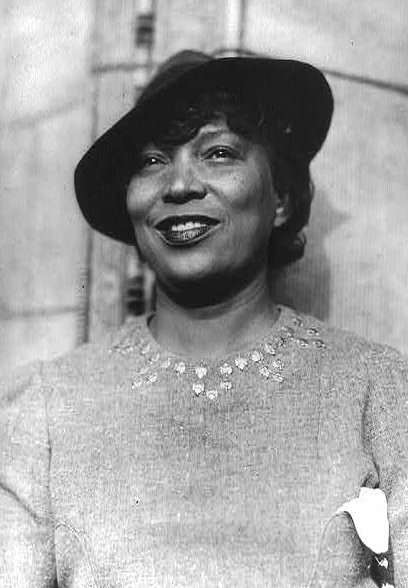
Of course, most people are familiar with Zora Neale Hurston and her books because Halle Berry starred in the 2005 TV movie adaptation of Their Eyes Were WatchingGod produced by Oprah Winfrey. The Harlem Renaissance bad girl was not only a celebrated novelist and playwright but a noted anthropologist as well.She produced ethnographic films in 1928 capturing the lives, customs, and beliefs of Southern people.If you are ever in the Library of Congress, be sure to check Hurston’s filmography.
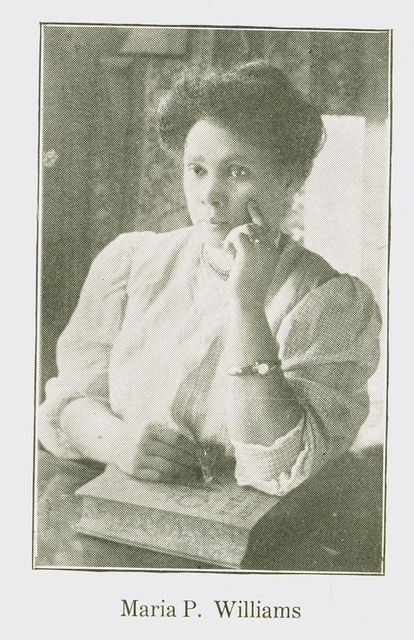
Seven years before Hurston’s films and exactly 100 years before #OscarsSoWhite was trending, the legendary Black newspaper TheChicago Defender mentioned the “three-reel drama” Shadowed by the Devil, penned and produced by Mrs. Miles Webb, in their section “Among the Movies.” Around the same time, photographer Jane Louise VanDerZee Toussaint Welcome, personal photographer of Booker T. Washington and sister of famed Harlem photographer James VanDerZee, and her husband Ernest Toussaint Welcome opened The Toussaint Motion Picture Exchange.Jennie directed Doing their Bit, a short detailing the efforts of Blacks in the military during WWI. Another film pioneer, Maria P. Williams, produced, distributed, and acted in her own film, The Flames of Wrath (1923) and the Norfolk Journal and Guide printed, “Kansas City is claiming the honor of having the first colored woman film producer in the United States.” And Williams’ best friend, Tressie Souders was lauded by the Black press as the first African American woman director for her film, A Woman’s Error (1922), which was distributed by the Afro-American Film Exhibitors’ Company based in Kansas City, Mo.These woman ignored stereotypes, Jim Crow laws, and the lack of women’s rights to get behind camera to capture and document important stories.They used a pen and a camera to create important pathways and springboards to fuel the march to equality.
It is important to mention, since we are talking about woman who used film to impact the social consciousness of a very racially oppressive society, the writer Drusilla Dunjee Houston.She wrote the screenplay, “Spirit of the South: The Maddened Mob,” one of earliest African-American responses to Thomas Dixon and D. W. Griffith’s The Birth of a Nation (1915).She was unable to get it financed and produced.
Black women have been involved in every aspect of film from the beginning.While Oscar Micheaux is regarded as the father of Black independent cinema, we must also applaud the women who stepped out prior to men and women of all races to create jobs, opportunities and provide authentic depictions of them on the screen.These woman found their own spark and seed money to create a lane, a voice and compelling narratives that would accurately depict African American life and inspire the next generation. They pioneered cinematic techniques and introduced ways to flourish outside of Hollywood.They were entrepreneurs with start-up film companies.Maybe one day, they will trend on twitter or receive posthumous recognition for their contributions. But they did not do it for fame or hardware, they saw a new industry that they could use to instill pride and confidence in their community and propel the race forward. So for this Black History Month, we can proudly say #EarlyCinemaSoBlack.
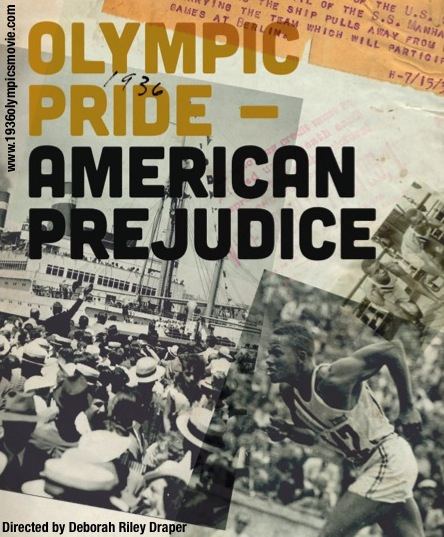
Though not cinematic pioneers, two historically significant women will be featured in the upcoming documentary Olympic Pride, American Prejudice.The film captures the heroic turn of 18 African American athletes who defied racism on both sides of the Atlantic to complete in the 1936 Olympics.And, Louise Stokes and Tydie Pickett, the first Black women ever selected to an American Olympic team, bravely and proudly stepped onto the U.S.S. Manhattan to represent the U.S. almost 30 years prior to the Civil Rights Bill.This film is currently funding on Seed&Spark.Please support the telling of this significant chapter in American history and a precursor in the modern Civil Rights movement.Click here to contribute or log on to www.1936olympicsmovie.com to learn more.
Filmmaker Deborah Riley Draper has a proven track record for creating compelling brand stories as an advertising agency executive. Draperʼs first documentary, Versailles ʼ73: American Runway Revolution, brought to life the legendary 1973 fashion battle between five French and five American designers. Versailles ʼ73 has screened all over the world and received acclaim from critics and fans alike, including the New York Times, LA Times and Harperʼs Bazaar. The film was selected to the St. Louis International Film Festival, NY Winter Film Awards, John Hopkins Film Festival, Marthaʼs Vineyards African American Film Festival, Denver Film Society Winter DocNights, and Gateway Documentary Festival as well as selected to screen at fashion and design festivals in Canada, Saudi Arabia, Croatia, Estonia and Australia. Versailles ʼ73 is distributed through Cinetic/Filmbuff on VOD in North America, Europe and Australia. The documentary has also been optioned for development into a feature film.
Draper is currently completing production on Olympic Pride, American Prejudice, the story of the 18 African American athletes of the 1936 Summer Olympic Games. She is also completing two feature film scripts. Draper recently contributed to several museum projects, including The Groninger Museum in The Netherlands exhibition on Marga Weiman, Museum of the City of New Yorkʼs Stephen Burrows: When Fashion Danced and the Andre Leon Tallyʼs An American Master of Inventive Design at SCAD. Draper will be a contributing writer to the Fall 2015 NKA: Journal of Contemporary African Art Fashion Edition.
Draper has been making long format content and commercials for more than 15 years for clients such as Coca-Cola Classic, Sprite, The Georgia Lottery Corporation, Blue Cross-Blue Shield, ExxonMobil, Fedex, Bayer CropScience and HP. She is currently the Client Service Director at Iris Worldwide. Prior to iris, Draper spent eight years at BBDO and three years at the Publicis network agency Burrell Communications Group. Her advertising work has won two Regional Emmy Awards, Gold Effie, and numerous Addys.
The avid Florida State University Seminole is frequent lecturer for the AAAA Advertising Institute and a 2014 Distinquished Visiting Professor at Johnson & Wales University, Florida Campus.
“The movies we screen here tend to be unfiltered,” Barnard President Debora Spar told me on the red carpet of the Athena Film Festival Saturday night. “They’re powerful. They’re different voices. And we just want to provide a platform to get those voices out there.”
“The movies we screen here tend to be unfiltered,” Barnard President Debora Spar told me on the red carpet of the Athena Film Festival Saturday night. “They’re powerful. They’re different voices. And we just want to provide a platform to get those voices out there.”
The Athena Film Festival, co-founded by Kathryn Kolbert and Melissa Silverstein, just ended its impressive fifth year last weekend, Feb. 5 through 8, and featured a strong slate of films, panels, documentaries and shorts focusing on female protagonists and filmmakers.
The film festival ended on a strong note with the screening of Difret, based on a true story about the abduction of a 14-year-old girl in an Ethiopian village kidnapped on her way home from school. She killed her captor after he raped and beat her, and the subsequent trial riveted the country and started a national conversation about child brides. The film, directed by Zereseney Berhane Mehari and produced by Mehret Mandefro, is executive produced by Angelina Jolie. It was Ethiopia’s submission for best film foreign Oscar and will be released in this country in March.
Gina Prince-Bythewood and Melissa Silverstein
But back to the awards ceremony Saturday night, where Olympus Has Fallen actor Dylan McDermott–the only man on the red carpet and a member of Barnard College Board of Trustees–told me he wished there were more female directors. He noted that he made a film directed by Jodie Foster–Home for the Holidays back in 1995–and that Joanne Woodward discovered him while he was doing a workshop and later mentored him and changed his life: “She was maybe the best director I ever worked with.” He added, “I find that women directors are very different from men. Their sensitivity and their vision are a lot different. The two best directors I worked with were women.”
Athena honoree, Beyond the Lights director Gina Prince-Bythewood, told me on the red carpet she was excited about being in the company of women whose work she held in high esteem. “That definitely got me on the plane out here from L.A. to the Athena Film Festival; I’ve heard so many great things about it. Amma Asante was honored last year and we’ve become good friends during this whole awards season. And just that it’s a festival focusing on women and the importance of female filmmakers,” she noted. “There is a difference between female and male filmmakers, and it’s really about the point of view and what we focus on with our female characters, so it’s a beautiful thing to be a part of it, and I hope that honestly I can see some cool films and be inspired as well.”
The filmmaker told me her next film will focus on female friendship and the way it changes over time. “It’s a little more comedic in tone” than her previous works, referencing Beyond the Lights, which was screened later that night at the festival to a packed audience, and at which the filmmaker participated in a lively Q&A. “I love finding young voices, people that have something to say and have chops, and I think that’s my responsibility as one that’s gotten through the door to reach back and help others as well.”
Gina Prince-Bythewood
I asked the filmmaker her reaction to the Oscar nominations. “There were a number of people who should have been in the conversation,” she told me. “There were no people of color nominated in any of the acting categories. I mean David (Oyelowo) obviously should have been nominated. Gugu (Mbatha-Raw), who gave two phenomenal performances (Beyond the Lights and Belle) that were 180 degrees from each other; any other actress would have been exalted after that,” she said. “The problem is the drumbeat for her happened too late. It should have happened out of Toronto, but I’m excited for what’s next for her. I just hate that she’s not in the conversation right now.”
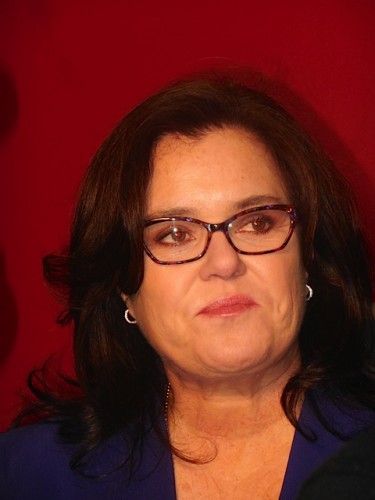
Rosie O’Donnell generated a frenzy of media attention on the red carpet as she made her first public appearance since she announced her marital split from Michelle Rounds and her exit from The View. She attended the premiere of her documentary, Rosie O’Donnell: A Heartfelt Stand Up, and later presented the President’s Visionary Award to HBO Documentary President Sheila Nevins.
O’Donnell told journalists on the red carpet her decision to leave the popular daytime talk show, which was just announced the previous day, was a decision she made with her doctor. She suffered a heart attack in 2014, and her doctor carefully monitored her health and told her after the holidays she had an uptick in numbers that indicated an increased risk of a heart attack, possibly as a result of stress from work and her personal life.
Dylan McDermott
O’Donnell cautioned that all women should take care of their health but conceded she knew she was fortunate. “It’s not everyone who can take a break from working because of stress. It’s easy for me because I’m very rich, right? So I have a lot of help. So it’s easy for people like me to talk about it. I have somebody to watch the baby if I don’t feel like it, so I have a much easier life than 99.9 percent of women on the planet and I know that. But every woman needs to take their health seriously,” she said. “I ignored it, my own. I didn’t really participate in anything besides mammograms cause my mother died of breast cancer. I was so sure it would be breast cancer that got me, so when I had a heart attack I was stunned.”
A few days earlier Jodie Foster received the Laura Ziskin Lifetime Achievement Award and was supposed to attend the awards ceremony Saturday but had to jet back to L.A. for the Director’s Guild Awards in which she received two nominations.
During the Athena awards ceremony, via video, Foster, who has been an actress since she was a child, noted that, “There I was a young girl wanting to be a director and never seeing a female director’s face. I thought it was something I would never be allowed to do.” After her mother took her to a film festival of works by Italian director Lina Wertmuller, Foster said, “I came to realize that I could be a woman director if I wanted to because there was one out there, and that was a life-changing moment for me.”
Debora Spar and Dylan McDermott
The awards ceremony, which turned out to be a great party attended primarily by women, honored Gina Prince-Bythewood, producer Cathy Schulman, and HBO Documentary Films President Sheila Nevins.
O’Donnell, who presented Sheila Nevins with her award, noted that she fell in love with documentaries from the time she saw Grey Gardens. Then subsequently she’d see documentaries on HBO and every documentary she said, “has a name and it’s Sheila Nevins. Who is this witch I thought to myself?” O’Donnell met Nevins back in 1996, “when most of you Barnard students were in elementary school.”
O’Donnell said of Nevins, “She’s the woman I look up to the most in all of showbiz. Her heart is the biggest of anyone, and she’s got a Geiger counter for truth that’s never failed.” She added that she’s done six or seven documentaries with the HBO Documentary head that does the heavy lifting. “I give her a tremendous amount of credit, and I do very little work, and that’s how I like it.”
Melissa Silverstein and Kathryn Kolbert
In a speech that was basically a stand-up comedy routine, O’Donnell also joked that she saw a woman who walked by wearing a grey hat, who caught her attention. The woman sat at a front table and O’Donnell cracked, “I saw you walking by and I’m like, ‘I don’t know who she is, but she might be my next wife.’” The audience roared. O’Donnell added the feeling might not be mutual and segued into a dig at Brian Williams: “Maybe that’s the problem in my relationships. I see someone and I make shit up like Brian Williams. I escaped on 9/11 from the Twin Towers. Oh No, I didn’t. I got mixed up. F—ing Lance Armstrong liar.”
Gina Prince-Bythewood’s emotional and heartfelt speech about her journey as a filmmaker was the evening’s highlight. She spoke about being adopted by white parents and her search for her birth mother that didn’t work out as hoped. She began her journey as a filmmaker with a rejection from film school but that didn’t deter her: “I wrote a letter to the head of the school telling her she made a mistake. She called me and said I’m in.”
Bythewood credited much of her success to other women who advised and mentored her, including A Different World producer Susan Fales Hill, who presented Bythewood with her award.
Sheila Nevins and Rosie O’Donnell
Bythewood said that people asked her all the time about discrimination against Black directors. “I’ve personally not been discriminated against,” she said. “What is discriminated against are my choices, which is to focus on women and especially on women of color, their goals and their love stories and it’s a tougher fight.” A fight made especially difficult because only 4 percent of directors are women in the Directors Guild, and in the Writers Guild it is only 10 percent, “which means that our images of females that young women … are seeing is from a male point of view, and I think that that’s frightening. I think that’s dangerous and just ignores our perspective. It’s not just what happened at the Oscars,” she said. “It’s the fact also that of the films nominated for best picture not one has a female protagonist and is from a female point of view, and that has got to change. I’m in that fight.”
Paula Schwartz is a veteran journalist who worked at the New York Times for three decades. For five years she was the Baguette for the New York Times movie awards blog Carpetbaggers. Before that she worked on the New York Times night life column, Boldface, where she covered the celebrity beat. She endured a poke in the ribs by Elijah Wood’s publicist, was ejected from a party by Michael Douglas’s flak after he didn’t appreciate what she wrote, and endured numerous other indignities to get a story. More happily she interviewed major actors and directors–all of whom were good company and extremely kind–including Brad Pitt, Angelina Jolie, Morgan Freeman, Clint Eastwood, Christopher Plummer, Dustin Hoffman and the hammy pooch “Uggie” from The Artist. Her idea of heaven is watching at least three movies in a row with an appreciative audience that’s not texting. Her work has appeared in Moviemaker, more.com, showbiz411 and reelifewithjane.com.