 |
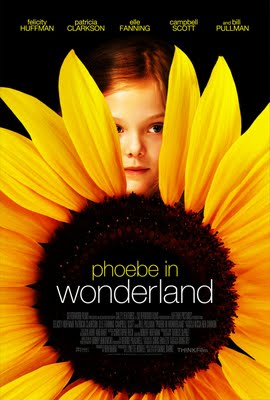
| Movie poster for Phoebe in Wonderland |
imdb plot summary: The movie focuses on an exceptional young girl whose troubling retreat into fantasy draws the concern of both her dejected mother and her unusually perceptive drama teacher. Phoebe is a talented young student who longs to take part in the school production of Alice in Wonderland, but whose bizarre behavior sets her well apart from her carefree classmates.
Well, on the surface, the movie is about Phoebe and her struggle to fit in with her peers. But it quickly turns into an examination of motherhood and parenting in general, when Phoebe’s odd behavior gradually worsens: she spits at classmates, she obsessively repeats words and curses involuntarily, she washes her hands to the point that they bleed—and she explains to her parents over and over again that she can’t help it. However, her mother (and father), being academic writer-types (Hillary is actually attempting to finish her dissertation on Alice in Wonderland), merely choose to see their daughter as nothing more than eccentric and imaginative.
The caretaker r ole falls exclusively to Hillary. She’s a stay-at-home mom trying to write a book while also attempting to care for two young daughters. While her struggle to play The Good Mom definitely lends sympathy to her character—I mean, honestly, what the hell is a good mom?—I couldn’t help but despise her selfishness and blatant disregard for Phoebe’s needs. Even though both parents decide to (finally) get Phoebe into therapy, it’s Hillary who refuses to accept the doctor’s diagnosis, even going so far as to remove Phoebe from therapy, deliberately hiding the diagnosis from her husband.
The problem here, and where the movie most succeeds, is that Hillary feels alone as a parent. She believes that her children’s struggles will ultimately reflect poorly on her as The Good Mom, and she even says at one point that she doesn’t want her daughter to be “less than.” Obviously, we live in a society that mandates the over-the-top importance of living up to an unattainable standard of proper mothering (see: any celebrity mother and the scrutiny she faces, with barely a mention of celebrity fathers), and Hillary definitely effectively represents that unattainable standard.
 successfully portrays the societal trend of the working father: he pokes his head in when necessary, checking in on his daughters, and demonstrating just the right balance between quirky annoyance at their neediness and curiosity about their daily lives—he shows up to parent/teacher conferences, he consoles Phoebe when she gets in trouble at school, and he genuinely wants to participate; he’s just not required to maintain the role of The Good Dad—it doesn’t exist.