Seed & Spark: ‘Gloria’: Dancing On Her Own

As we watch Gloria’s flailing, her triumphs, her mistakes, her fun, we can’t help but be reminded (and I was just by typing all those words) of another single lady on a smaller screen and a familiar part of the feminist zeitgeist: Girls’ Hannah Horvath. Only living in Santiago, Chile, all growed up. I’ve seen a couple of Gloria reviews mention Girls, but almost always in the context of the film’s sex scenes, the sort not traditionally shown, between bodies wider audiences (or producers) aren’t generally begging to see nude. But the character similarities don’t end there. Though they are generations and cultures apart, it continues with their flighty boyfriends, with their finding themselves alone in a dress on a beach without their belongings, with their ability to be irritating and down-to-earth simultaneously, and with their love of dancing.

This is a guest post by Amanda Trokan.

1
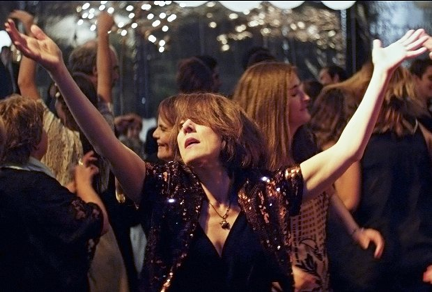
Gloria (Paulina Garcia)


2
Girls (Lena Dunham)


This is not a review of (the life-affirming! Berlin Festival prize-winning! Dare I say glorious?) Chilean comedy-drama Gloria.  No.  This is a call, nay an order, no, no a call (I’m an indecisive lady, right?) for women under 50 to go see a film that depicts a woman over 50 in such a way that you just might leave the theater as excited to get old (well, older, while we’re being polite) as I did.  Not despite its titular character’s spinsterhood, but surprisingly because of it.

Gloria is no kind grandma stepping in to take care of the family when the leading-lady daughter’s marriage falls apart, nor a lonely grandma dealing with an ailing husband, nor a stubborn grandma slowly getting ill herself, nor the sassy single grandma making one-liners about her granddaughter’s sex life from the periphery.  All that, one might expect from Hollywood.  The 58-year-old divorcee grandma in Gloria (played by the vibrant Paulina García) is the center of our story as she casually takes up dating again, but mostly just continues living.  And I mean really living.

I would like to say “living it up” here, but that phrase might suggest living lavish or fabulously.  And while I personally think her life falls under that definition—smoking weed, having sex, romantic weekending—I understand the subjective nature of my opinion on lifestyle choices.  (I tend to see the fun, or at least “interesting experience,” in waking up solo by the sea missing a shoe after a night of gambling—as Gloria does—rather than the shame in it.)  What I objectively mean is: she is existing no differently from a woman of any other age, with some age-specific issues (ex-spouses, children, gastroplasty) but mostly universal, adult ones.

In Gloria, we are swiftly pulled into Gloria’s day-to-day life as she flirts, drinks, dances, deals with the various characters in her apartment complex, gives her blessing to her pregnant daughter who’s moving abroad for love, and embarks upon a new relationship with Rodolfo (Sergio Hernández), who has a family of his own to manage.

As we watch Gloria’s flailing, her triumphs, her mistakes, her fun, we can’t help but be reminded (and I was just by typing all those words) of another single lady on a smaller screen and a familiar part of the feminist zeitgeist: Girls’ Hannah Horvath.  Only living in Santiago, Chile, all growed up.  I’ve seen a couple of Gloria reviews mention Girls, but almost always in the context of the film’s sex scenes, the sort not traditionally shown, between bodies wider audiences (or producers) aren’t generally begging to see nude.  But the character similarities don’t end there.  Though they are generations and cultures apart, it continues with their flighty boyfriends, with their finding themselves alone in a dress on a beach without their belongings, with their ability to be irritating and down-to-earth simultaneously, and with their love of dancing.

3

4

Don’t get me wrong, I am not implying direct influence here.  But if I must make the ubiquitous Girls connection in order for the female masses (ew?) to get out and experience this film and understand that getting older is going to be A-OK, that we don’t need to hurry up to find a partner and figure out who we are, that we don’t need Botox or lipo to get naked after 40, that we don’t need to fit into one of two categories, career woman or mom, and that we don’t need to fear being alone (and I don’t just mean single here, I mean physically alone)—well then the ends justify the means.

Here’s the thing, women over 50 should watch it, too.  In the same way that I enjoy watching Girls because it gives me that thank-heavens-I’m-not-dealing-with-that-nonsense anymore feeling, the 50-pluses might get a thrill out of Gloria’s life not being their own anymore, or on the flip side it might completely resonate.  Win, win!  Because while it may seem like some big secret of growing old has been revealed to us in Gloria (or at least to me, a 31-year-old)—namely that we actually will still have those young brains in those old bodies—women of a similar age as Gloria might feel satisfaction seeing themselves or people they know represented more accurately on screen.

You could garner exactly none of this from Gloria, and it’d still be a really good time.  But for me, it was refreshing to see a female-led film where the moral of the story isn’t the girlie best-friendships above all else, nor the incomparable bond with your mom, nor your unconditional devotion to your daughter, nor the knowing nod from your sister.  It is about learning to love dancing on your own.

[youtube_sc url=”http://www.youtube.com/embed/h9PrVESAYeA?rel=0″]


Amanda headshot

Amanda Trokan is a writer turned Seed&Spark Director of Content. Watcher of many   films, lover of some. Winner of 1993 West Road Elementary D.A.R.E. essay and two 2013 Oscar® pools; loser of hair thingies.  Follow @trokan on Twitter for insight into her likes/dislikes/whatever.
‘Ass Backwards’: A Refreshing Buddy Comedy With No Regrets

They hitch a ride from a biker feminist who takes them to an all-women’s commune (“We live in a world very far removed from beauty pageants,” they say, after releasing Kate and Chloe from “the fraudulent chains of patriarchy”). There are some silly stereotypes in this scene, but Kate and Chloe are the tone-deaf ones (as always), and the older feminists are sympathetic and admirable. When they worry about their lack of appeal to the younger generation, Kate and Chloe step up to help them with a business plan–and they don’t know what they’re talking about. They just make fools of themselves, and don’t understand the consequences of their actions. (Could this be a criticism of third-wave feminism? I’d like to think so.)


Ass Backwards

“We’re not losers.” “We’re Kate and Chloe.” – Ass Backwards


Written by Leigh Kolb

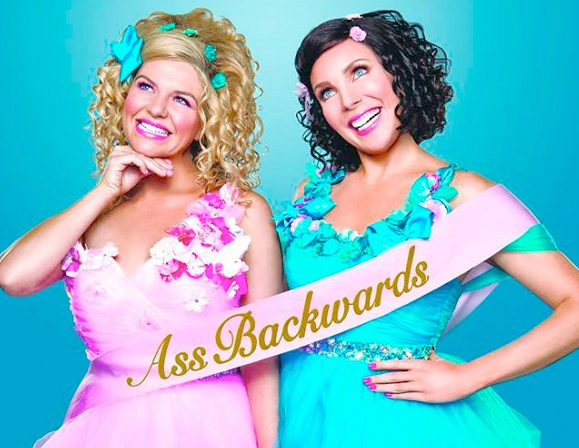
Ass Backwards is a purposefully uncomfortable ride that follows two best friends–Kate and Chloe–as they attempt (and consistently fail) to get somewhere with their lives. The road-trip buddy comedy follows the two as they deal with internal and external road blocks on their way back to their hometown. The destination? To compete in a 50th anniversary beauty pageant that they’d lost as children. “If we go back there, we will win,” they confidently say as they disregard an eviction notice from their Manhattan apartment.

June Diane Raphael and Casey Wilson co-wrote and co-star in the film (as Kate and Chloe, respectively), and their acting skills shine. The comedy has its moments of brilliance, but doesn’t seem as strong as it could be, given the duo’s talent. A strong supporting cast (a wonderful Alicia Silverstone, Vincent D’Ornofrio, Jon Cryer and Bob Odenkirk) gives a strong backbone to a sometimes-wobbly film.

[youtube_sc url=”http://www.youtube.com/watch?v=W23rE3u1ce8″]

Ass Backwards has been receiving pretty negative reviews since it was released on VOD on Sept. 30 (its theatrical release is Nov. 8). The film has a number of rough spots (the bunny subplot and children in the woods, I’m looking at you), but I can’t help but wonder if our discomfort at seeing delusional women who humiliate themselves without a shred of self-awareness is partly to blame for audiences’ reactions.

This isn’t something we’re used to–seeing women characters embrace their failing lives with pride. The two have “dead-end” jobs (Chloe dances at a nightclub, and Kate is a “CEO” of her own business, which is selling her eggs to infertile couples), but they are proud. Their lives are spiraling downward, but they love themselves, and one another.

While the laughs aren’t on par with Dumb and Dumber, it’s a similar concept–two somewhat-but-not-really-lovable morons who don’t understand how relatively terrible their lives are. Audiences love and accept the “loser” male comedy hero, but his female counterpart feels awkward and foreign.

I’m not totally defending Ass Backwards as comedy gold. It has some hilarious moments and many groan-worthy moments (as most comedies do). I value it very much for what it is, however: a film that highlights female friendship, female-centric comedy, and female characters who are remarkably flawed. For all of its flaws, the writers took risks and gave us a comedy that receives an off-the-charts score on the Bechdel Test.

Ass-Backwards-e1359037482685
Chloe (left) and Kate hitchhike and get the unexpected.

And there are some great moments in Ass Backwards. When the two flash back to their childhood pageant days, Kate is asked in the interview portion, “When you’re a mommy, do you want to enter the work force, or stay at home?” She stumbles, and answers, “Workplaces are where people work.” The pageant host (Odenkirk) calls her a “moron,” and she’s laughed off the stage.

In the talent portion, Chloe (young Chloe is played by the wonderful Ursula Parker of Louie fame) sings/wails, “Stand by your man.”

“Those were the days,” Chloe wistfully remembers as an adult. When Kate looks pained by the memory, Chloe consoles her: “Your answer wasn’t easy, and that scares people.”

The funny, pointed critique of the pageant industry’s problematic relationship with little girls (and expectations of women in general) is clear.

Alicia Silverstone is excellent as Laurel, who won that pageant and has become and a veritable “winner” in adulthood. (Her charity, “Laurel’s Ladies,” gives “makeovers to low-income gals so they can look like me, if only for a day.”) When Kate and Chloe attend her book-signing, she tells them they would qualify for Laurel’s Ladies. They are simply confused; why would they need that?

As they set out on their road trip, there are plenty of hiccups. When Kate drives hours in the wrong direction, Chloe isn’t angry at all. Moments like this highlight the strength of their friendship. Toward the climax of the film, there is some in-fighting between the two, but it never delves into stereotypical cat fight territory–and this is refreshing.

They hitch a ride from a biker feminist who takes them to an all-women’s commune (“We live in a world very far removed from beauty pageants,” they say, after releasing Kate and Chloe from “the fraudulent chains of patriarchy”). There are some silly stereotypes in this scene, but Kate and Chloe are the tone-deaf ones (as always), and the older feminists are sympathetic and admirable. When they worry about their lack of appeal to the younger generation, Kate and Chloe step up to help them with a business plan–and they don’t know what they’re talking about. They just make fools of themselves, and don’t understand the consequences of their actions. (Could this be a criticism of third-wave feminism? I’d like to think so.)

They sing along proudly to a song that isn't quite right.
They sing along proudly to a song that isn’t quite right.

The women continue on, stripping by accident, landing in jail, seeking shelter with their favorite reality star, and finally end up at the beauty pageant (after they’ve released what’s been holding them back).

The pageant scene is as disastrous as we expect, and the epilogue is heartwarming and darkly humorous.

Comedies are hard to get just right, which is evident from the dearth of good ones–especially ones with female protagonists. For that fact alone, Ass Backwards is refreshing and exciting.

During the 50th anniversary pageant, Kate is asked about the strides that women have made in the last half a century. She is flustered, and finally gathers herself. She answers, “I don’t have a fucking clue. I don’t know.” She smiles, and proudly walks off stage.

Sometimes that is the best we can do. Smile, admit we have no fucking clue, and move on. Kate and Chloe aren’t losers, and Ass Backwards isn’t a loser, either. Ass Backwards is Kate and Chloe, and they have no regrets.

I have no regrets, either, having spent an hour and a half with Kate and Chloe. The line “Her ‘mones–she must be off her ‘mones” was alone worth the cost of the VOD rental.

Wilson and Raphael make quite the writing and acting team. As writers, they have sold two comedies (Mason Twins on NBC and DINKS on ABC) for this development season, and are set to be big winners in the world of comedy.

__________________________________________________________


Leigh Kolb
 is a composition, literature and journalism instructor at a community college in rural Missouri. 

Notes from the Telluride Film Festival: Reviews of ‘The Past’ and ‘Ida’

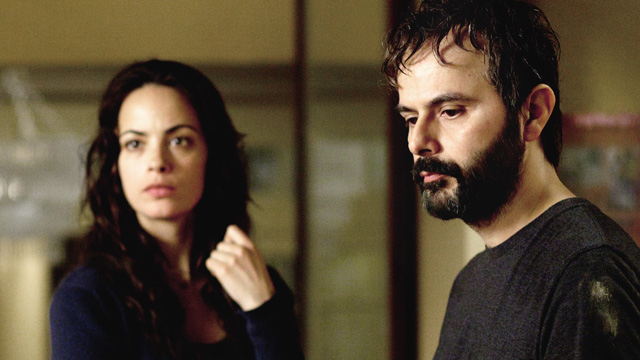
We learn in The Past that not is all as it seems, and maybe all that is left in the past isn’t really. Academy Award-winning director Asghar Farhadi (2011’s The Seperation) returns with his first movie outside of Iran. Ahmad (Ali Mosaffa) returns from Iran to finalize his divorce with Marie-Anne (Berenice Bejo, 2011’s The Artist) and finds himself awkwardly sleeping at the house of her new boyfriend, which also contains her children.

Film still from The Past


This is a guest post by Atima Omara-Alwala.

It’s in the Past, or Is It Really? A Review of The Past

We learn in The Past that not is all as it seems, and maybe all that is left in the past isn’t really. Academy Award-winning director Asghar Farhadi (2011’s The Seperation) returns with his first movie outside of Iran. Ahmad (Ali Mosaffa) returns from Iran to finalize his divorce with Marie-Anne (Berenice Bejo, 2011’s The Artist) and finds himself awkwardly sleeping at the house of her new boyfriend, which also contains her children.

Director Asghar Farhadi is Iranian, and in speaking about the film, addressed how he hopes–as someone from the East–that people from the East and the West can better understand one another through film. Certainly, The Past is, among many things, one of those movies that aims to dispel notions about his Iranian characters. First, the movie has a major female protagonist in Marie-Anne as the ex wife of Ahmad, in addition to her daughter Lucie, who is in a supporting role. Marie-Anne is a woman with a solid career as a pharmacist. Ahmad is an Iranian man, who adores children and is better with them than his soon-to-be ex-wife, and he enjoys cooking for his ex-wife and the children. The Western portrayal of Iranian men (or men from the Middle East) tends to show men as very patriarchal who treat women with disdain (eg, Not Without My Daughter). As if to ensure the viewer that Ahmad is not a one hit wonder, Marie-Anne also is in a serious relationship with a new Iranian man, Samir (Tamir Rahim) who is a single, devoted father to his son Fouad after his wife ends up in the hospital in a coma from a suicide attempt.

A web of secrets from the past threatens to destroy the lives of all the characters; how they grapple with it and deal with them (or if they do) is what makes this film riveting to watch for all viewers (as it has universal themes).

A must see by a talented director.

Film still from Ida


The Odd Couple: A Review of the Film Ida

Ida is a wonderfully-directed film by Polish director Paweł Pawlikowsk about two women learning about themselves and their family together. Anna (Agata Trzebuchowska) is a novice, an orphan brought up by nuns in a convent. Before she takes her vows, she is told of her only living relative, Wanda (Agata Kulesza), whom she seeks out to find the answers about her family.

Anna finds out she’s really not Catholic, but Jewish, according to her Aunt Wanda.

Wanda, a somber woman, wondering about what happened to her sister’s family (Anna’s parents) agrees to take a journey with her to find out what happened. It is a journey both women take that forces them to learn about each other, and it challenges each other’s beliefs.

You learn Wanda has fallen a bit in her career. Formerly a powerful attorney and judge in Communist Poland, you quickly see Wanda’s brilliance, intensity, and hardness. You see slices of what Wanda must have been when she demands answers on what happened to her sister from the family that now lives in her sister’s home. “You know I can destroy your life,” says Wanda. Anna is quiet and demure, a perfect product of her Catholic upbringing and at times clearly does not know what to make of her Aunt.

Putting a devout young sheltered Catholic woman with a wordly Polish Jewish woman is bound to create tension. When Anna quietly, but clearly, disapproves of her Aunt Wanda’s dancing, drinking, and flirting with men on one of their road trip stops, Wanda senses this and points out how Anna’s Jesus hung out with women like her (alluding to Mary Magdalene).

The saddest moment in the journey awaits them as they find out what really happened to their family. How they both deal with that tragedy and are impacted by their interactions with each other carries the last third of the film poignantly.

Shot in black and white, it resonates of a darker time in Poland. This is a must see because the story is touching and Paweł Pawlikowsk portrays the depths that are these women characters. Despite Anna being a novice on her way to being a nun and Wanda being a powerful career woman, they are not caricatures but real characters with feelings and desires who are figuring out their lives.


Atima Omara-Alwala is a political strategist and activist of 10 years who has served as staff on 8 federal and local political campaigns and other progressive causes. Atima’s work has had a particular focus on women’s political empowerment & leadership, reproductive justice, health care, communities of color and how gender and race is reflected in pop culture. Her writings on the topics have also been featured at Ms. Magazine, Women’s Enews, and RH Reality Check.


Does ‘Gravity’ Live Up to the Hype?

Gravity survives on the merit of its spectacle. It’s beautiful, terrifying, and gripping. The characters, while feeling real, are underdeveloped. The story itself is one big metaphor for Stone’s journey into isolation and despair after suffering personal tragedy. It is an epic allegory about the journey toward life, toward connection with the earth. I couldn’t tell you what kind of card player Stone is, though, or what made her want to become a doctor. Her life is a blank because she’s not an individual; she’s an archetype.

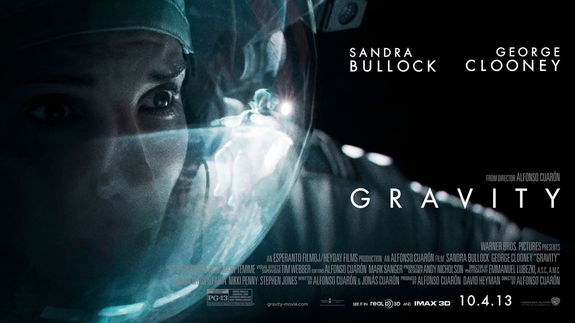
"Gravity" Movie Poster
Gravity Movie Poster

Written by Amanda Rodriguez
Spoiler Alert

Alfonso Curon’s Gravity is primarily an experience. It’s an edge-of-your-seat survival tale set in the vastness, the darkness, the solitude of space. I was eager to review this film because I love sci-fi, and I love women in sci-fi flicks. I can take or leave Sandra Bullock (mostly leave her), but her performance in Gravity‘s opening sequence sold me:

It’s silent in space. Astronauts are working on the exterior of a space satellite. George Clooney as astronaut Matt Kowalski  is floating about making pleasant conversation. We can hear the labored breathing of Dr. Ryan Stone (Sandra Bullock). Her heart rate is elevated, and she’s not taking in the majesty of space because she’s too focused on her work, too focused on keeping herself under control. Dr. Stone is not an astronaut. She’s a civilian medical engineer who’s designed some special program that NASA wants to use. Trained solely for this mission, she’s fighting not to have a panic attack while perched outside the world, and then she is violently wrenched from that perch, from that narrow margin of the illusion of safety into…chaos.

Sandra Bullock as Dr. Ryan Stone desperately holds on as a debris storm destroys everything around her.
Sandra Bullock as Dr. Ryan Stone desperately holds on as a debris storm wreaks havoc.

No other film has communicated to me the desolation of space the way that Gravity does. Dr. Stone’s vulnerability and lack of awe translate into a visceral feeling within this audience member of the true terror and anxiety of being in space, the smallness of the human animal, and the rawness of her grip on survival.

Gravity‘s cinematography is stunningly beautiful. The film is shot with such a unique style, and its zero gravity environments faced so many challenges that the movie’s innovations are being lauded as “chang[ing] the vocabulary of filmmaking.” They used puppeteers for Christ’s sake! How cool is that? Some shots did seem indulgent, perhaps trying too hard to convey Cuaron’s metaphor. The best example being when Stone makes it into a damaged space station that still has air. She disrobes in slo-mo from her suit, and the exactness of her body’s poses are anime-esque in their echoing of the fetus in the womb and birth metaphors.

Though in booty shorts, Stone is never stripped to her bra & panties.
Though in booty shorts, Stone is never stripped to only her bra & panties.

I liked Ryan Stone’s vulnerability and her constant battle with blind panic (that she sometimes loses). It made her and her experience more accessible. It’s iffy whether or not Gravity, though, manages to be a feminist film. Gravity certainly doesn’t pass the Bechdel test, but to be fair, there are very few characters at all in the movie. The only personal detail we’re given about Stone is that she was once a mother who lost her daughter to a tragic accident. This irks me because it casts Stone as the grieving mother archetype. Boooorrriiiinggg. It too simply explains her unhappy adventure beyond the ends of the earth. It forgives her for being a woman who would give up familial ties to go into space because she, in fact, has already lost those ties. Because her loss consumes her, Stone’s despair and lack of connection, in fact, justify her trip.

Clooney's Kowalski calmly tows an oxygen deprived Stone to safety.
Clooney’s Kowalski calmly tows an oxygen deprived Stone to safety.

Veteran astronaut Kowalski is a bit too perfect, too in-control, and too optimistic. When we contrast his cool command with Stone’s panic attacks, freezing up, and bouts of giving up from which he must coax her, Kowalski seems like more of the hero. That leaves Stone to be the basketcase woman whom it is Kowalski’s chivalrous duty to rescue. Stone finally encounters a situation that seems unbeatable, and she resigns herself to death. She hallucinates Kowalski comes to rescue her and gives her the information lurking in the back of her memory that she needs to save herself. He is her savior even within her mind. Not only that, but as she rouses herself from her hallucination, she says something like, “Kowalski, you clever bastard.” This leaves open the interpretation to spiritual types that she may not have, in fact, hallucinated; instead she may have had a supernatural experience in which her friend’s ghost did save her life from beyond the grave deus ex machina style. Frankly, that is just poop. Either way, Clooney as the noble, infinitely calm and self-sacrificing astronaut dude is just spreading it on a bit too thick for my taste.

Kowalski helps a flustered Stone speed up her slow work.

Gravity survives on the merit of its spectacle. It is beautiful, terrifying, and gripping. The characters, while feeling real, are underdeveloped. The story itself is one big metaphor for Stone’s journey into isolation and despair after suffering personal tragedy. It is an epic allegory about the journey toward life, toward connection with the earth, which is a poignant, compelling story, but I couldn’t tell you what kind of card player Stone is or what made her want to become a doctor. Her life is a blank because she’s not an individual; she’s an archetype. If Gravity could have accomplished its visual feats, told its epic story about survival and rediscovering the self all the while giving us rich characters, I would have loved this movie. Instead, I merely like it for its grandness of vision and its ideas; I like it in spite of its tepid storyline and lukewarm characterizations.


Miley Cyrus Has America’s Sex Drive By The Balls

But what I do want to talk about is the conversation that has swirled around young Cyrus ever since the ill-fated twerking incident at the VMA’s, and her subsequent music video of her naked on a wrecking ball. Everyone has slut-shamed Miley Cyrus. They’ve wagged their fingers at her dance moves, her tongue, her hair-cut, her entire demeanor, her (unsurprising) change from Disney star to adult, her drug-use, and the fact that she’s just “not a role model for young girls.”

Because apparently America thinks, as it has for the past, I dunno, forever, that female sexuality is “icky.”

Written By Rachel Redfern

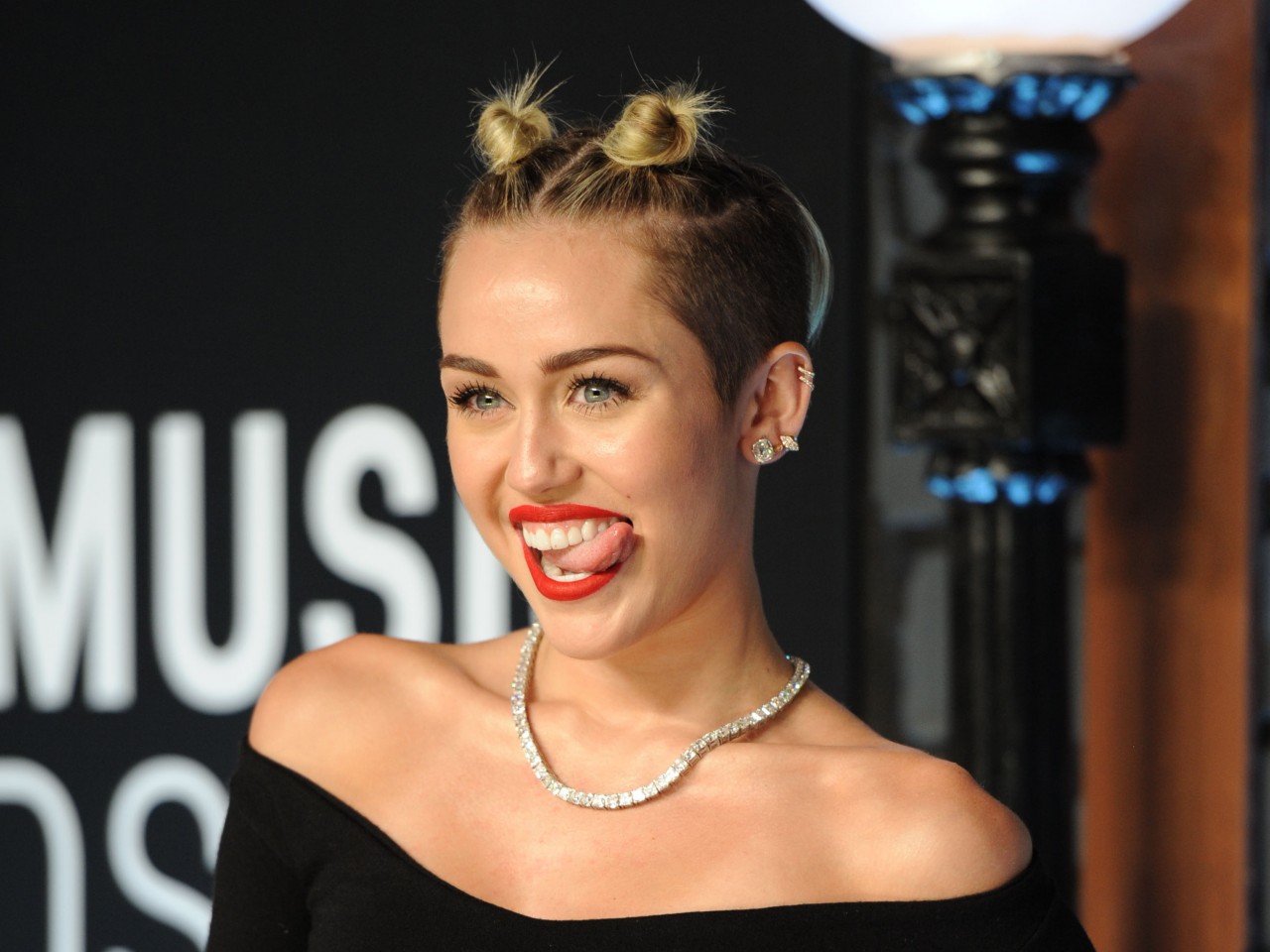
Miley and the tongue

Over the weekend you might have noticed the Sinead O’Connor and Miley Cyrus kerfuffle that happened on the internet. The whole thing started when Miley Cyrus states that the Irish singer was one of her idols; a little while later, O’Connor posted this public letter to Cyrus, “advising” her; though really, her advice sounded a lot like condescending, passive-aggressive slut-shaming. So Cyrus then acted out an immature and hurtful scene on twitter by referencing O’Connor’s personal struggle with mental and emotional health. Sinead then descended to the 20-year-old pop star’s level and posted an irate tirade on facebook, cussing out the young singer and just plain-old aggressively calling her a “prostitute.”

The whole thing is horrible and ridiculous and both have acted badly and today, I’m not here to defend or support either of them.

But what I do want to talk about is the conversation that has swirled around young Cyrus ever since the ill-fated twerking incident at the VMA’s, and her subsequent music video of her naked on a wrecking ball. Everyone has slut-shamed Miley Cyrus. They’ve wagged their fingers at her dance moves, her tongue, her hair-cut, her entire demeanor, her (unsurprising) change from Disney star to adult, her drug-use, and the fact that she’s just “not a role model for young girls.”

Because apparently America thinks, as it has for the past, I dunno, forever, that female sexuality is “icky.”

News flash: she’s a POP SINGER. Like Madonna, Cyndi Lauper, Britney Spears, Christina Aquilera, Nicki Minaj, Rihanna, Lady Gaga, and virtually EVER OTHER FEMALE POP STAR OF THE PAST 40 YEARS.

And of course the real issue here isn’t that each of these women has had a bout with a dirty dance move and a lot of flesh showing on camera, but rather, that they dared to do it and not feel ashamed. That they dared to do it and own it as a part of who they were, a part of their own sexuality. Because this is what people are really scared of, they’re scared of women’s sexuality just like they always have been. If Miley takes her clothes off and grinds on a wrecking ball in front of their little girl, then someday, their little girl, or little girlfriend, or little wife, might do they same.

You know what world. They are. And some are going to like it.

But I know what you’re thinking, “How dare they like it?!” “There will be no liking of sex!” “Good girls don’t like sex.”

Scary thing about all this? Sometimes, BOYS DO IT TOO! Only nobody really cares if boys do it because they’re uncontrollable sex maniacs anyways, amiright?

And the big thing is, pop singers have been doing this for a long time, to generate controversy, get attention, and sell albums.

Welcome to showbiz, baby.

And you know what, someday, maybe Miley Cyrus will look back on all this and regret it. But maybe she won’t. Maybe she’ll be a sex-icon like Madonna for the rest of her life and make millions of dollars and be perfectly happy.

Now, I applaud O’Connor for pointing out the insidious nature of much of the music business executives and the way that they are using the female stars in their contracts. However, it’s possible that Cyrus, who literally grew up in the music industry, is also a market-savvy pop princess entirely aware of the best way to keep herself current and in demand: controversy.

And since she’s embraced her rebel idol status with a rockin’ hair cut and intense tongue use, part of that is expressing an overt, in-your-face sexuality with stunning confidence.

For some reason, America (and much of the world), fears that deep V between a women’s legs and the fact that we like having access to it. For some reason, it’s incomprehensible that some women might enjoy taking off her clothes and feeling the thrill of voyeurism.  Some women, just like some men, love excess and attention and the body is a powerful way to get those things

As media reviewers who pay a lot of attention to female interaction with the media, we often complain the inappropriate sexual exploitation of women, specifically when that happens with the goal of a directed male gaze.  For example, these stupid superhero posters with ridiculously designed uber-feminine poses.

The way women really stand
The way women really stand.

But female sexuality that aggressively maintains control over what it wants and how it chooses to be presented? Well, I can get behind that because it’s her choice.

We also complain when that sexuality is lacking in substance and obviously operating off of a limiting standard of female beauty. As an image think of Megax Fox straddling a motorcycle in booty shorts for no other reason than Michael Bay wanted her to.

How Megan Fox looks when her car breaks down
How Megan Fox looks when her car breaks down.

But super spiky bleach blond hair whilst wearing tennis shoes and a bear-studded leotard? Sure, whatever.

Amanda Palmer, that brilliant musician and feminist extraordinaire, once got fully nude at a concert FILLED with people in a fierce reclaiming of her own body after a snarky post by the Daily Mail. Nudity and sexiness won that day. She’s also written her own letter to Cyrus and its awesome.

Lady Gaga, (Funny feminist Caitlin Moran once wrote in stellar praise of the pop singer), who I’ve seen more times without clothes than I have with, is considered an eccentric purveyor of the avant-garde and hyper-camp. And while she’s occasionally controversial, no one is writing her open letters demanding that she put some clothes back and stop gyrating.

It’s because of age. As always, Miley’s coming out into the realm of the adult, from a coveted child star’s position, means that she must always be sweet and funny and America’s girl-next-door.

But here’s the thing, she is America’s girl next door. At least some of them. She’s experimenting and projecting herself, just do it in a far more public one than your average 21-year-old. And making a lot more money.

Miley Cyrus  and the infamous bears
Miley Cyrus and the infamous bears.

So America, get over yourself and your Victorian, false-nostalgia ideas about what a women’s libido is really like. Cause you’re babbling and my vagina and I have better things to with our time.


We Need A Different Game: ‘Tiger Lily Road’

From Aristophanes’ Lysistrata to contemporary men-are-from-Mars neurobabble, there has been a Western cultural tendency to view male-female relations in military terms, as a “battle of the sexes.” As a veteran of both teams, and even more so as a feminist who disputes gender essentialism, binarism, and cissexism, I find this framing deeply tiresome and hopelessly passé, and it’s hard to know what to with cultural products that revisit it.

“You can’t force him, Louise.”

“Why not? If it was you or me tied up in there, they wouldn’t hesitate. It’s why they join the army, so they can rape and pillage and–”

“He’s not in the army!”

“He’s in the army of men. And he’s a prisoner of war.”

From Aristophanes’ Lysistrata to contemporary men-are-from-Mars neurobabble, there has been a Western cultural tendency to view male-female relations in military terms, as a “battle of the sexes.” As a veteran of both teams, and even more so as a feminist who disputes gender essentialism, binarism, and cissexism, I find this framing deeply tiresome and hopelessly passé, and it’s hard to know what to with cultural products that revisit it.

If this is true, what am I? Benedict Arnold?

This is why I absolutely cannot make up my mind about Michael Medeiros’ film Tiger Lily Road, which is so oddly pitched that I can’t decide how to read it. Medeiros has averred that “Dark comedy can illuminate aspects of the soul usually left in shadow in lighter treatments,” but I’m not entirely sure what aspects of the soul are being illuminated here, unless they’re ones that are hugely more cynical about human nature and gender relations than I am.

The IMDb plot outline runs thus: “Two small-town women accidentally capture a handsome young fugitive.” Blonde, gentle veterinarian Annie and vampish brunette Louise are both middle-aged, single, and disillusioned with romance. When douchey young criminal Ricky stumbles into their lives, they find themselves acting in unprecedented ways.

Both within the film and in the director’s statements, the allusion to Thelma and Louise is made explicit. From Tiger Lily Road‘s Facebook page:

This film, which could not exist without Callie Khouri’s ground-breaking screenplay, Thelma and Louise, asks the question: where are we now? Are we still frozen in mid-air as in Ridley Scott’s boldly edited ending? Or have we crash-landed in some new and twisted territory…

Still the best friendship

Thelma and Louise is certainly still depressingly relevant some twenty-odd years later: rape survivors still get scrutinized, mainstream films that pass the Bechdel test are still vanishingly rare, men are still inundated with violent power fantasies and women are not. The awesome thing about Thelma and Louise is its portrayal of the titular women’s friendship – as Sophie Standing wrote last year, “nothing is more important than their loyalty to each other, and they are empowered by their freedom and refusal of male domination.” I’m not fully convinced that the women of Tiger Lily Road even like each other. Certainly there’s far more onscreen evidence of bonding between Annie and Ricky than between Annie and Louise.

Not that Annie and Ricky’s relationship is healthy (the Misery allusion might have tipped you off). If this film is meant to be an empowerment fantasy, it’s a creepy and depressing one where women’s relationships with men are cast as either the mother, with blonde Annie’s 50 Shades of Grey emotional fixer-upper thing (“He’s damaged!”), or the whore, with dark-haired Louise raping Ricky using the physical means of Viagra. If it’s a cautionary tale exploring the perils of a “battle of the sexes” worldview, it’s certainly stylishly made, particularly one standout sequence near the end, but it’s very strange tonally.

The SYMBOLISM, do you see it

But then, maybe the point is to unsettle us. Pop culture is full of male empowerment fantasies that are objectively creepy and depressing, but we’re so inured that we don’t take them seriously. Maybe the reason this one discomfits me is because I’m just not used to it. Or maybe because I know the writer-director is a man, and I’m not certain that his portrayal of gender relations is a helpful one.

In the end, even though he’s a nasty piece of work who manipulates Annie’s trust and naivety with film quotes, Ricky perhaps makes the film’s best point. Annie shows him a picture of a co-ed soccer team from their childhood and laments growing up and separating along gender lines: “We couldn’t be on the same team anymore.” Ricky replies, “Maybe you just need a different game.”

Amen to that.

Max Thornton blogs at Gay Christian Geek, tumbles as trans substantial, and is slowly learning to twitter at @RainicornMax.

Bitch Flicks’ Weekly Picks

From a Saudi Arabian female filmmaker to loving your body to privilege–check out what we’ve been reading about this week! What have you been reading/writing this week? Tell us in the comments!

Saudi Arabian Film “Wadjda” Quietly Subverts and Stuns by Sarah Mirk at Bitch Media

The Big O: How Sandra Bullock Found Her Own Sense of Gravity by Susan Wloszczyna at Women and Hollywood

Homeland and Mental Illness by Melissa McEwan at Shakesville

The Female Anti-Hero in “Masters of Sex” by Alyssa Rosenberg at Bitch Media

Fanboys Don’t Like Black Widow’s ‘Huge’ Role in the Avengers Sequel by Alexander Abad-Santos at The Atlantic Wire

Why ‘It’s Like a 13-Hour Movie’ Fails to Do Justice to Great TV by Ronan Doyle at Indiewire

Women Film Pioneers Project at Columbia University

Meet Chris Nee, creator of Disney’s “Doc McStuffins” by Lorena Ruiz at msnbc

Quote of the Day: Jennifer Lawrence to Hollywood’s Diet Police “Go F*** Yourself” by Kerensa Cadenas at Women and Hollywood

Natalie Portman On The Real Meaning of Feminism at Huffington Post

The Feministing Five: Mariska Hargitay by Suzanna at Feministing

Fox Buys Diablo Cody/Fake Empire Drama by Nellie Andreeva at Deadline Hollywood

OWN: Oprah Winfrey Network Presents Special Night of Programming on Being Gay in America by Tambay A. Obenson at Shadow and Act

Stars Bring Laughter, Tears to Variety’s Power of Women Luncheon by AJ Marechal at Variety

Loving Your Body in the Age of Patriarchy by Sam at Autostraddle

Why We Still Need to Talk About Privilege by Jamilah King at Colorlines

Stop Dismissing Young Female Musicians as “Inauthentic” by Carl Wilson at Slate


What have you been reading/writing this week? Tell us in the comments!

Welcome New Staff Writer, Jaye Johnson: I Fancy Meeting You Here

Entertainment, metaphysically speaking, has to do with entertaining yourself: noshing on and indulging in ideas that make you happy and/or bring catharsis. Entertainment is in essence a tantric release. To that end, no media is too “high rent or low rent” in my world.

​”Character is plot, plot is character.” – F. Scott Fitzgerald

I am ever-enchanted by other people, places and things, yet I am a decidedly boring person: I shy away from offering up my own biography or “Top 5 of Top 10” lists when presented with such requests. As I’m writing this, I have one eye on the door.
However, if you want to talk about Maya Deren’s filmic existence and off-camera metaphysical meanderings…or the progressive feminist undercurrents in RuPaul’s catchphrases and so-called competitions (Child…! Don’t you know RuPaul Charles is down with performativity as pedagogy? RuPaul’s Drag Race is a queering of The Real Housewives tropes!), then I’m your girl.

I love people–therefore I love the art of the story. Narrative. Otherworlds that are somehow familiar. Oneness.

In my thinking, creativity and spirituality are synonymous.

Entertainment, metaphysically speaking, has to do with entertaining yourself: noshing on and indulging in ideas that make you happy and/or bring catharsis. Entertainment is in essence a tantric release. To that end, no media is too “high rent or low rent” in my world.

Maybe it’d be best to tell you what I do. Finally.

In a “forever novice status:” I’m a writer, singer, beat-maker, guitar player (heck: musician.) and occasional painter.

You can find more of my meanderings at HerGlitter.com, here at Bitch Flicks, at GayAgenda.com, and the Huffington Post.

Feel free to connect with me by clicking here, or tweets are welcome @jayevajohnson.

Seed & Spark: Princess of the 22 Clark Bus

The idea for THE DREAMERS came to me over time. I saw it in the periphery of my vision as I woke up at 4 a.m. to go work the opening shift at my day job. I felt it pulling at the hem of my secondhand cargo jacket as I biked the heinous Chicago streets from one six-hour shift to another. I heard it in the stories and anecdotes of my fellow artists and friends as they struggled just like I did. It got to the point where I felt like I was being haunted.

Photo Credit Kelsey Jorissen Photography


I’m thirteen years old and staring open-mouthed at the ending credits. Immediately I hit the stop button, eject the DVD, and reinsert it into the player. Again. I have to see Princess Mononoke speak her mind, stick up for the sprits, and save the forest again. Then a third time. And then six more times. And then twice more for my friends who hadn’t seen it yet. No shame. I was completely blindsided by the power and grace of this story. The princess of the wolves was incredible, and not only was she a fucking badass… she was a she.

As a 20-something female operating in a big city far far away from the confines of her small town where everyone goes to the Polar Bear Diner for breakfast on Sundays, there came a day when I realized I had to stop waiting for permission. In 2011 I graduated from DePaul’s Acting Program with a solid education, a hefty repertoire of monologues for 20-something females, and a whole hell of a lot of anxiety. That first summer out of college was a cluster fuck. I got mugged on the CTA, I lost friends, I had to put my cat to sleep, I watched fellow artists give up, I had my heart broken into a million pieces, and I got rejection after rejection from talent agencies. Never had I felt so alone and lost.

My solace was going to the movies. It always had been. Much to my dismay that whole first year out of school I didn’t see a single movie in theaters that made me want to go right back, watch it again, and then show my friends. So you mean that the token female character clad in a cat suit is supposed to pass as an excuse for me to connect with a film? Well maybe if she was given more than a poor excuse for one-liners and a sensibly tight mid shot of her perfect 24-inch waist and 36-inch bust I would have paid attention. I’m sorry. I missed the memo on black lycra-wearing women are better seen and not heard. The stories were without spirit. The characters weren’t saving any forests anytime soon. At the end of the day I felt stigmatized. Where was the epic and sweeping storytelling that made me pursue this career path in the first place? What type of women were these filmmakers catering to? Certainly not the intelligent and capable females I knew. There are single women, there are married women, there are homosexual women, there are women who love dead lifting, there are women who love whiskey, there are women who are mothers, and there are women who really enjoy pirates. However there is one group we all fall under. The fact is that we all have a valid opinion.

Beauty shot of main character, Kara, in THE DREAMERS. Set up took two hours …

The idea for THE DREAMERS came to me over time. I saw it in the periphery of my vision as I woke up at 4 a.m. to go work the opening shift at my day job. I felt it pulling at the hem of my secondhand cargo jacket as I biked the heinous Chicago streets from one six-hour shift to another. I heard it in the stories and anecdotes of my fellow artists and friends as they struggled just like I did. It got to the point where I felt like I was being haunted. The creative spirit world was calling to me wake the fuck up and just make it happen. Come on Princess of the 22 Clark Bus. Get with it. Hear our cry.

So I answered. At the beginning of 2013 I took a step away from answering casting calls, and Facebook posts, from text messages, and booking myself straight through the day from sunrise to sundown. Instead I turned on some Beyonce, made myself a big ass cup of French roast coffee, and sat down to write the first season of THE DREAMERS. Three months later I held in my hands the story of one female artist and her five friends as they try to navigate the unbalanced world of post-graduation. Over the course of the process of writing the first season I realized this series was a way to bring much-needed exposure to other artists working in Chicago. The heart beat of this show is that of the hundreds of actors, singers, theatre companies, installations artists, photographers, and musicians that inhabit the streets of the Second City. Why not expose the musical talent of my friends who turn pop music into Latin-fusion? Why not feature the hilariously talented ladies of Awkward Pause Theatre Company? Why not create a show that brings other artists into the limelight alongside these fictional characters? Initially I was shocked at how quick the universe was to respond. But when you are a young struggling artist writing a show about young struggling artists, it’s not that hard to find a group of young struggling artists who want nothing more than to create that story with you.

Filming the final scene for the pilot episode of The Dreamers.
Filming the final scene for the pilot episode of THE DREAMERS.

Producing and directing is problem solving on crack. It hit me that I had to speak louder in order to be heard. I had to be braver, smarter, faster, kinder, and most of all willing to fall flat on my face an infinite number of times if this show was ever going to get off the ground. As I look back on my process for the filming of the first episode I feel that being a female has worked to my advantage. People trust you. I cannot tell you how many meetings I have walked into donning my mental, emotional, and creative armor, ready to work any angle to get the yes I needed in order to make this web series a reality, only to be met with equal compromise and kindness. I am the only female on my crew, but they respect me and trust me because I send thank you notes. I make us breakfast at the beginning of a 12-hour shoot day. This show takes a village and I am only the sum of the dozen  dedicated crew and cast members. As a woman I know how to appreciate, how to communicate, and how to listen. We are expert collaborators, because we’re hardwired to be.

The tides are turning. I think of the glowing faces of female filmmakers like Lena Dunham, Jennifer Westfeldt, and Brit Marling. Their body of work is compelling, honest, and raw. Their films are not meant to reach only one demographic of people, nor are they meant to reach only one type of woman. These filmmakers are breaking walls, speaking their minds, but most importantly- telling stories worth telling. And that is what it comes down to, being brave enough to say it out loud. And guess what? We women are here to understand a good story when we see it just as much as men are. We are equally as capable to walk into theatre with a pair of eyes, a set of ears, and a heart absorb it all. On that fact alone we are worth quality storytelling.


Kelsey Jorissen
Kelsey Jorissen

Kelsey Jorissen hails from Cottage Grove, Minnesota. She has been making movies since the age of seven when she recreated Grease in her garage with a VHS camcorder. She graduated with a BFA in Acting from DePaul University’s Theatre School in 2011. After graduation she collaborated on a number of films projects with DePaul film students as well as finished her first feature film SanctuaryAlongside film she has worked as a professional stage actress. Alongside acting she works as a freelance photographer and runs her own small business at Kelsey Jorissen Photography. She aims to live a fulfilling life of adventure and mayhem with her beloved cat, Momo. So far so good.

Wonder Woman Short Fan Film Reminds Us to Want this Blockbuster

In two and a half minutes, this fan trailer makes the case for Wonder Woman being compelling to watch both in the modern world and in her mythical origins. Actress Rileah Vanderbilt conveys a lot of Diana’s personality without the benefit of dialogue, and convincingly throws down with a gang of criminals AND gigantic minotaurs [note for non-geeks: Wonder Woman is at least as strong as Superman. It is supposed to look relatively effortless when she smacks thuggish men out of her way. The fight choreography here manages to convey that even with Wonder Woman’s punches and jabs looking genuinely forceful]. The modern-day setting has the gritty urban feel that DC movies seem to have settled on as a brand, and this Wonder Woman doesn’t look out of place there.

In my last post, I lamented that Marvel’s Stan Lee showed an industry-typical disinterest in creating movies about female comic book characters, especially in the interest of Marvel’s great lineup of women.

But it is DC that owns THE iconic female comic book character: Wonder Woman. And no one is holding their breath for a Wonder Woman movie. (Note: if you are holding your breath for a Wonder Woman movie, PLEASE STOP. You will die.)

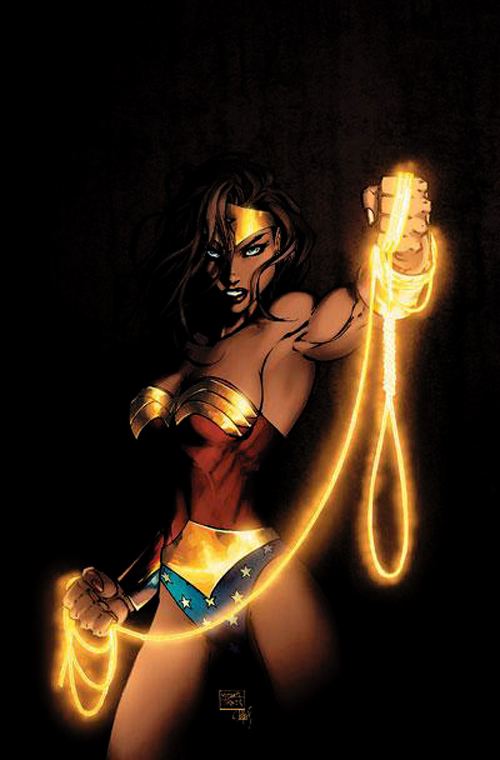
Wonder Woman in cover for Identity Crisis #4 by Michael Turner

Like I said about Marvel, there will always be excuses. There’s no bankable actress with the right body type to play the character (because everyone knew Henry Cavill before Man of Steel, right?) She’s more of an icon than a consistently realized character. (Hire the right writers and that won’t be a problem!) Wonder Woman is too chintzy, with its Greek mythology and invisible jet (keep in mind that Marvel’s Thor has a sequel coming out next month).

Thor
The Thor movie was not at all cheesy.

These are all bogus lies and we know it. Hollywood just doesn’t believe movies about women can make money, so they won’t make them.

But we have to keep refuting these lies if we’re ever going to get anywhere, and this gorgeous short fan film reminds us that Wonder Woman absolutely could carry her own Hollywood movie:

In two and a half minutes, this fan trailer makes the case for Wonder Woman being compelling to watch both in the modern world and in her mythical origins. Actress Rileah Vanderbilt conveys a lot of Diana’s personality without the benefit of dialogue, and convincingly throws down with a gang of criminals AND gigantic minotaurs. (Note for non-geeks: Wonder Woman is at least as strong as Superman. It is supposed to look relatively effortless when she smacks thuggish men out of her way. The fight choreography here manages to convey that even with Wonder Woman’s punches and jabs looking genuinely forceful.) The modern-day setting has the gritty urban feel that DC movies seem to have settled on as a brand, and this Wonder Woman doesn’t look out of place there.

This short is more than just another compelling argument for a Wonder Woman movie–it’s a fine piece of art in itself. Kudos to Rainfall Films for bringing us this delight and furthering the case for a Wonder Woman movie. I hope this gets enough attention that DC gets the message.

Not Another Teenaged Drama: A Review of ‘Palo Alto’

Palo Alto is what would happen if Mean Girls had a major collision with American Beauty. The picturesque neighborhoods with the homes of the screwed up parents of the main characters was entirely reminiscent of American Beauty. The parents’ self-absorption was stunning at times. And every time April’s high school girl classmates talked, it was like nails on a chalkboard (cue: Mean Girls’ Regina George, Gretchen Weiners, Karen Smith WITHOUT the comedy).

palo_alto_1

This is a guest post by Atima Omara-Alwala.

The next generation of directing Coppolas has come of age in Gia Coppola’s (granddaughter of renowned director Francis Ford Coppola) teenage angst drama featured in the American suburbs. Palo Alto is from a collection of short stories by actor James Franco (who knew he was a writer?), who stars in the film himself.

The main focus is around teenaged April (played by Emma Roberts, daughter of actor Eric Roberts) and Teddy (Jack Kilmer, Val Kilmer’s son) and their parallel existences with occasional touches on the lives of their fellow high school classmates who are obsessed with sex, substances, and suicide. The link between April and Teddy is that April likes Teddy, Teddy likes April–but because they’re teenagers, they never get around to saying it until much later into the film. In between this, April has a short-lived fling with her soccer coach, Mr. B (a very smarmy James Franco), and Teddy has a fling with Emily (Zoe Levin) (read: random fellatio at a house party). Also, Emily has a fling with Teddy’s best friend Fred (Nat Wolff), an all-star sociopathic misogynist.

gia-coppola-palo-alto-venice-film-festival-2013-1-3_horizontal

Indeed, it is a tad heartbreaking to see how quickly Fred jumps back into his jeans after bedding Emily and callously views her deflated face afterwards or, in another scene, how he pushes Emily down to her knees for some oral attention–all the while demanding she tell him what an amazing guy he is. Emily is that girl you knew in high school who you A) thought was cool because she seemed outwardly confident, and sexually precocious (when you didn’t have a clue) and B) was being endlessly slut shamed for it by all the jealous “mean girls”–which, of course, happens in this film.

For all her outward confidence, Emily is really looking to be valued and validated. So it’s even more painfully awkward as a viewer when Emily keeps going back to Fred until finally, in a major pivotal scene, she’s had enough of his verbal and emotional abuse. Meanwhile, April is trying to figure out her “relationship” with Mr. B and her feelings for Teddy. It is hinted that the relationship April has with Mr. B is perhaps due to the lack of attention at home from a less-than-interested mother and an eccentric stepfather (played by Val Kilmer).

-1

This is Gia Coppola’s first movie and not bad all around, but it was not revolutionary, and it is a story line that has been done more times than is necessary already: Y’know, the white middle-class to upper middle-class privileged kids who are bored and reckless–and who have no idea why they are so bored and reckless.

Palo Alto is what would happen if Mean Girls had a major collision with American Beauty. The picturesque neighborhoods with the homes of the screwed up parents of the main characters was entirely reminiscent of American Beauty. The parents’ self-absorption was stunning at times. And every time April’s high school girl classmates talked, it was like nails on a chalkboard (cue: Mean Girls’ Regina George, Gretchen Weiners, Karen Smith WITHOUT the comedy). There was very little diversity, no people of color except one or two as extras (which is often the case in a lot of suburbs anyway), and the only discussion of LGBT issues was Emily (who is already tagged as a whore) admitting to having done a girl-on-girl thing in a spirited game of “Never Have I Ever” (great).

265712_10200758233416428_492199539_o

If you went to high school in the suburbs and want a nowhere near humorous and somewhat awkward reminder of the whole experience, Palo Alto is your film.


Atima Omara-Alwala is a political strategist and activist of 10 years who has served as staff on 8 federal and local political campaigns and other progressive causes. Atima’s work has had a particular focus on women’s political empowerment & leadership, reproductive justice, health care, communities of color and how gender and race is reflected in pop culture. Her writings on the topics have also been featured at Ms. Magazine, Women’s Enews, and RH Reality Check.


Is Marvel’s ‘Agents of S.H.I.E.L.D’ Promising?

Two out of the three female characters are women of color: Melinda May played by Ming-Na Wen and Skye played by Chloe Bennet. They’re both of Asian descent, which leaves me wishing there were also prominent Black and Latino characters, but maybe more will be introduced over time. I’ve got to say that the Asian hacker and the Asian martial arts expert are pretty stereotyped roles, but I’m living on faith in Joss that he’ll flesh those characters out in a way that takes them beyond their trite origins into fully rounded characters to whom we’re heartbreakingly attached.

Marvel’s Agents of S.H.I.E.L.D Poster

Written by Amanda Rodriguez

Wow, the title of Marvel’s Agents of S.H.I.E.L.D is a mouthful. It doesn’t exactly roll off the tongue. That said, I’m a huge fan of Joss Whedon. I should clarify, though. I loved Joss Whedon’s Buffy the Vampire Slayer, Angel, Firefly, Serenity, Much Ado About Nothing, and The Cabin in the Woods. I did not love Dollhouse OR The Avengers. My critique of Dollhouse was that it really underplayed the slavery and prostitution implications of the “dolls” who must do whatever they are commanded to do, never truly acknowledging that the Dollhouse was, in reality, a very high-priced brothel of sorts. As far as The Avengers go, frankly, I was just disappointed. It was better than, say, Thor, but that’s setting the bar a whole lot lower than I tend to expect from the smart, feminist, socially conscious Whedon. However, I’m always game and will always watch with an open mind a TV show with Whedon at the helm.

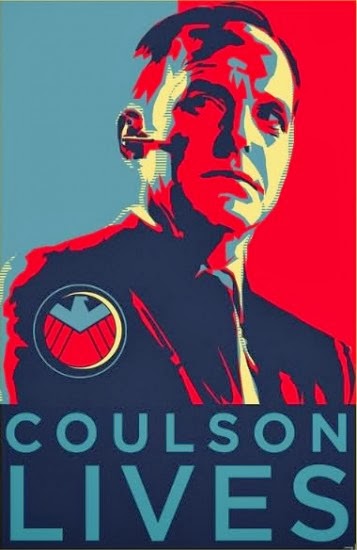
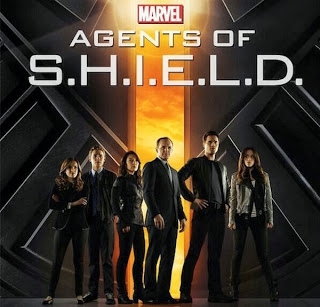
We’ve now got two episodes of the new Agents of S.H.I.E.L.D under our belts, so we have a bit of a base to gauge whether or not this show will be everything old-school Joss Whedon fans are looking for or if it’ll be superhero comic book fans’ hearts’ desires, or both (as the two are not necessarily mutually exclusive). As far as gender and diversity go, we’ve got three women and three men on the team (that’s right, Coulson is back), so there’s more of a balance than Whedon struck on his first go around in The Avengers with its lone female superhero, Black Widow.

His resurrection bears untold secrets that will doubtless unfold over time.

Two out of the three female characters are women of color: Melinda May played by Ming-Na Wen and Skye played by Chloe Bennet. They’re both of Asian descent, which leaves me wishing there were also prominent Black and Latino characters, but maybe more will be introduced over time. I’ve got to say that the Asian hacker and the Asian martial arts expert are pretty stereotyped roles, but I’m living on faith in Joss that he’ll flesh those characters out in a way that takes them beyond their trite origins into fully rounded characters to whom we’re heartbreakingly attached.

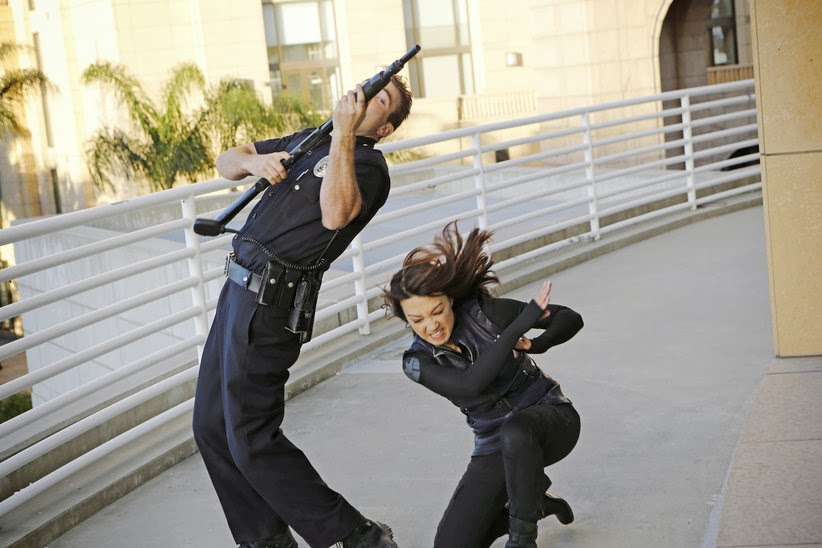
Melinda May is a veteran operative with a past to be reckoned with. Her asskickery is fluid and natural.

Melinda May getting it done.

Skye is a brilliant and gifted hacker who values information, truth, and humanity above all else. She’s also quick-witted and sharp-tongued.

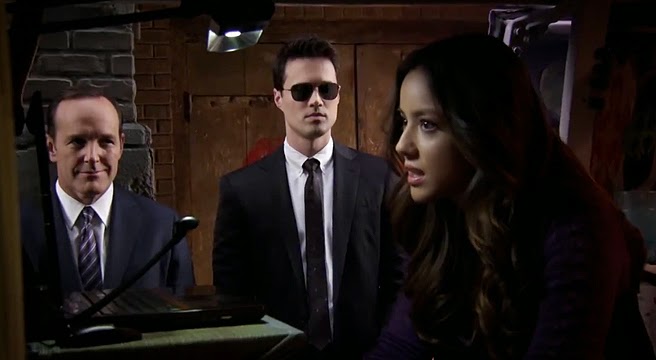
Coulson and Agent Ward discover Skye broadcasting from her seemingly secret mobile base…the van out of which she lives.

Episode one was a little lackluster. With too much going on, too many characters being introduced, too many techno gadgets, too much CGI, and too many awkwardly placed Joss Whedon signature jokes,  I was left feeling the show was trying too hard, and I was longing for the character depth and subject matter substance that Joss tends towards. The episode’s final speech is delivered by Gunn, I mean J. August Richards playing, Mike, the artificially enhanced unemployed ex-factory worker, and it refocused the show into what is important:

“You said if we worked hard, if we did right, we’d have a place. You said it was enough to be a man, but there’s better than man—there’s gods. And the rest of us? What are we? They’re giants. We’re what they step on.”

Mike performing a rescue using superpowers borrowed from
alien technology that will most likely kill him.

This isn’t just a speech about superpowers. This is a speech about our society, about the lie of the American dream. It’s saying that it’s no longer enough to work hard and be a good person. It’s a critique of the disparity of wealth and power, of our healthcare system, and our employment system (as Mike was fired for a workman’s comp back injury, which led him to undergo such drastic experimentation). This is a speech about the 99%. Having a Black man deliver it makes it all the more potent, referencing the deeply embedded racism in our country that insists upon assimilation but offers little reward or acceptance. Bravo, Joss.

Pilot episodes are notorious for trying to cram too much into an hour, and the trajectory of shows often change after that pilot, once they get their bearings. So how did Episode two, “0-8-4”, fare? It’s still a bit too flashy and gimmicky with too many explosions and frenetic fight sequences, but I enjoyed the use of the fancy-pants, newly commissioned S.H.I.E.L.D plane that seems as if it may serve as home base for the group…not unlike a certain ship helmed by the indomitable Malcolm Reynolds.

S.H.I.E.L.D’s apolitical mission with its interest in artifacts amongst a guerrilla war-torn Peru create a nice tension between its objectives and Skye’s very political, underdog/rebel sympathizing tendencies.  I hope she will continue to put these missions in perspective, not allowing the group to forget the geopolitical ramifications of their actions as well as the history and context of the places in which they practice resource extraction.

Coulson and his former colleague/lover Camilla Reyes make a deadly team fighting off rebels in Peru.

Episode “0-8-4” is really about one thing, though: teamwork, a specialty of Joss Whedon’s. Kelly West of Television Blend even dubbed the episode “Smells Like Team Spirit”. Right you are, Ms. West. I easily grow bored of overwrought gun fights with CGI that just won’t quit. Don’t get me wrong, I love the action genre with kickass fight choreography and heart-pounding do-or-die situations where characters must make impossible choices, but it’s got to have a soul. The team-building aspect of this episode, while a bit cheesy, gave the characters time to bond and to reveal snip-its about themselves, which had a generally humanizing effect and gave the audience an opportunity to warm to them.

Am I sold on Agents of S.H.I.E.L.D? Not yet. Do I think it has promise? Quite possibly. Will I keep watching? You bet your keister.


Bitch Flicks writer and editor Amanda Rodriguez is an environmental activist living in Asheville, North Carolina. She holds a BA from Antioch College in Yellow Springs, Ohio and an MFA in fiction writing from Queens University in Charlotte, NC. She writes all about food and drinking games on her blog Booze and Baking. Fun fact: while living in Kyoto, Japan, her house was attacked by monkeys.